Leave A Message
Tips: Kindly notice that reply of inquiry via email may went into spam, please kindly check your spam if you have sent inquiry email and do not receive replies, thank you.

Walking down the household cleaning aisle can feel a bit overwhelming these days. With so many colorful boxes, sustainable packaging options, and flashy marketing claims, picking the right detergent is no longer a simple task. At the very center of this modern kitchen dilemma is the great Dishwasher Pods vs Tablets debate. If you are looking to upgrade your dishwashing routine this year, you want a product that completely eliminates the need for tedious pre-rinsing, protects your delicate glassware, and gives you the absolute best bang for your buck. Everyone wants to know what the Best Dishwasher Detergent 2026 is, but how do you choose between a hard, chalky block and a squishy, multi-colored pouch?
Both options promise sparkling clean dishes, but they achieve this shared goal using vastly different chemical delivery systems and manufacturing processes. In this comprehensive guide, we are going to roll up our sleeves and dive deep into the nuts and bolts of Dishwasher Pods vs Tablets. We will explore how they are made, how they perform under pressure with tough food soils, their long-term environmental impact, and ultimately, which one deserves a permanent spot under your kitchen sink. Let’s settle the Dishwasher Pods vs Tablets debate once and for all so you can shop with confidence.
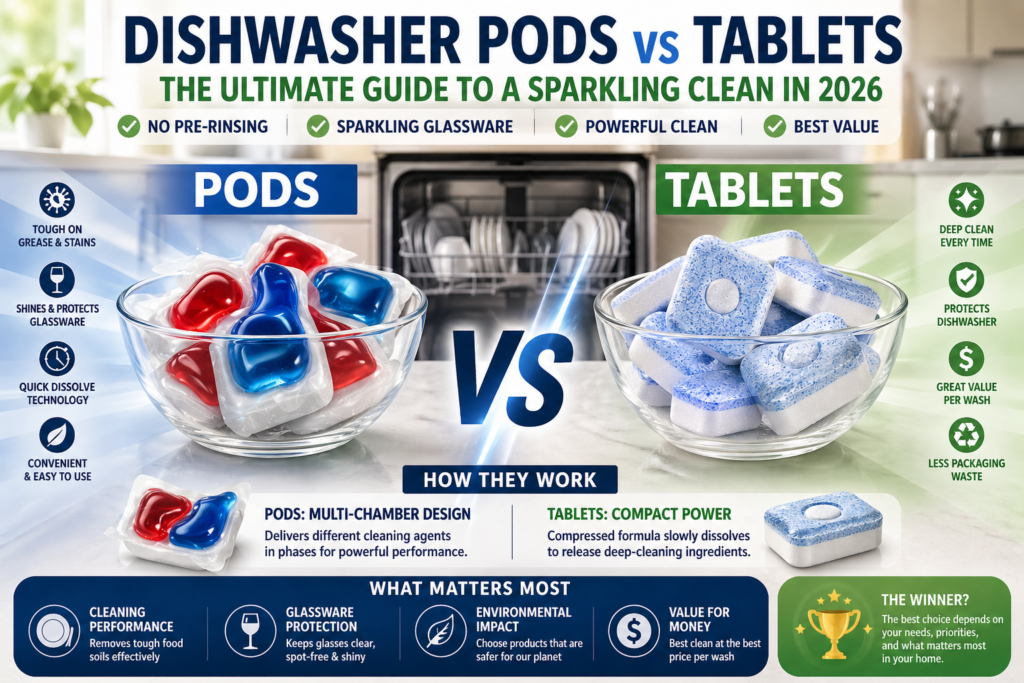
To truly grasp the complexities of the Dishwasher Pods vs Tablets comparison, we first need to look at the fascinating history and engineering behind these everyday household staples. For decades, the only option consumers had was messy, loose powder or bulky plastic jugs of liquid detergent. While they worked fine, people hated spilling powder everywhere or constantly guessing the right amount of liquid to pour. Enter the era of pre-measured convenience. Manufacturers realized that modern consumers wanted a simple, foolproof “toss and go” solution. This soaring demand led directly to the invention of the tablet, and later, the advanced pod.
While people often use the terms interchangeably in casual conversation, analyzing Dishwashing Pacs vs Pressed Tablets reveals they are quite different from an engineering standpoint. They look different, they feel different in your hand, and most importantly, they interact with the water in your dishwasher at vastly different speeds. When you close your dishwasher door and press start, a highly complex chemical ballet begins. Understanding the players in this ballet is crucial for making an informed choice in the Dishwasher Pods vs Tablets showdown. It isn’t just about soap; it is about sophisticated water softeners, rinse aids, and targeted enzymes working together in perfect harmony.
Dishwasher tablets are the older, slightly more traditional siblings in the pre-measured detergent family. When evaluating Dishwasher Pods vs Tablets, it’s helpful to know how tablets are formed. Generally speaking, a tablet is a tightly compressed block of highly concentrated detergent powder. When you open a standard box of tablets, you’ll usually find rectangular bricks that feel chalky to the touch. Sometimes they are wrapped in a thin layer of foil or plastic that you have to peel off before use, though many modern versions now feature a water-soluble wrapper to reduce hassle.
Tablets revolutionized the market because they concentrated intense cleaning power into a single, unchangeable dose. You couldn’t accidentally use too much or too little, saving money and preventing sudsy overflows. However, because they are compressed under immense pressure at the factory, they are incredibly dense. In the context of Dishwashing Pacs vs Pressed Tablets, this density means tablets require a significant amount of hot water and physical water agitation to break apart and activate fully during the wash cycle.
If you were to break a hard pressed tablet in half to see what makes it tick, you’d see a highly engineered mix of ingredients that define its role in the Dishwasher Pods vs Tablets rivalry. The bulk of the tablet consists of builders—chemicals designed specifically to soften hard water so the soap can actually do its job. Next, you have oxygen-based bleaches that tackle tough coffee and tea stains. Finally, there are the alkaline salts that break down massive grease deposits. Because these ingredients are pressed together into a solid brick, they all hit the water at roughly the exact same time once the tablet begins to dissolve. This “all-at-once” delivery system is great for long, heavy-duty cycles but can sometimes be a drawback if you are searching for the Best Dishwasher Detergent 2026 for quick, light washes.
On the other side of the Dishwasher Pods vs Tablets spectrum, we have the pod (often referred to as a pac). A pod looks like a tiny, liquid-filled pillow. Instead of being compressed into a hard brick, the active ingredients in a pod are encapsulated in a thin, transparent film made of Polyvinyl Alcohol (PVA). This film is scientifically designed to dissolve completely upon contact with water, making it a major talking point when comparing Dishwashing Pacs vs Pressed Tablets.
Pods represent the absolute cutting edge of home cleaning technology, positioning them as strong contenders for the title of Best Dishwasher Detergent 2026. Because the ingredients aren’t squeezed together, manufacturers can get incredibly creative with formulations. A single pod can hold powerful liquid degreasers, powdered enzymes, and a built-in liquid rinse aid, all kept entirely separate until the exact moment they are needed in the wash cycle. This flexibility is why so many users lean toward pacs in the Dishwasher Pods vs Tablets discussion.
The most distinct feature of a premium pod, and a massive advantage in the Dishwasher Pods vs Tablets debate, is its hybrid nature. You’ve likely noticed that many pods have multiple brightly colored chambers. This isn’t just for show. Certain cleaning chemicals actually neutralize each other if they sit in the same container for too long. For example, some powerful liquid surfactants can degrade delicate powder enzymes. By keeping the liquid rinse aid in a blue chamber, the grease-fighting liquid in a green chamber, and the scrubbing powder in the main compartment, the pod ensures that all chemicals remain at 100% potency until the PVA film melts away. This hybrid approach allows for a highly targeted, multi-stage cleaning process that hard tablets often struggle to match.
When it comes down to it, the primary reason you are heavily researching Dishwasher Pods vs Tablets is that you simply want clean dishes without the hassle. Nobody wants to open their dishwasher after a two-hour cycle only to find dried spinach stuck to a plate or a cloudy, unappetizing film coating their expensive wine glasses. Performance is the ultimate deciding factor when crowning the Best Dishwasher Detergent 2026. While both formats do an undeniably excellent job on lightly soiled loads, the real test of Dishwasher Pods vs Tablets happens when you throw in a baking dish covered in burnt-on lasagna cheese or a bowl crusted with dried oatmeal.
In the year 2026, dishwashers themselves have evolved dramatically. Modern machines use significantly less water and energy than older models, adhering to strict efficiency standards like the Energy Star guidelines. Because there is less water splashing around inside the tub, the detergent has to work twice as hard. It must dissolve rapidly, distribute evenly, and combat food soils without requiring extra water to rinse away the residue. Let’s break down how Dishwashing Pacs vs Pressed Tablets compare when the heat is turned up and the pressure is on.
When battling heavy, baked-on grease, the pod generally takes the lead in the Dishwasher Pods vs Tablets matchup. Because pods often contain specialized liquid surfactants in their separate chambers, these liquids are released immediately as the thin PVA film dissolves in the first few minutes of the cycle. This immediate release of liquid degreaser starts breaking down stubborn fats and oils much faster than a solid tablet, which needs more time to melt. This rapid action is a key reason many view pods as the Best Dishwasher Detergent 2026 for heavy-duty cooking cleanup.
However, we can’t count tablets out of the Dishwasher Pods vs Tablets fight when it comes to abrasive scrubbing power. The densely packed powder in a tablet can act as a gentle abrasive as it slowly breaks apart, helping to physically scrub away stubborn, starchy foods like dried rice or baked potatoes. But if you routinely skip the pre-rinse (which you absolutely should, to save precious water!), the fast-acting liquid-powder combo of a premium pod usually offers a slightly superior clean on the toughest heavy soils.
The true secret weapons in any modern detergent are enzymes. Protease enzymes eat proteins (like egg yolk), and amylase enzymes eat starches (like pasta). In the ongoing Dishwasher Pods vs Tablets evaluation, timing is absolutely everything. A tablet releases all of its enzymes simultaneously as the outer layer dissolves. A high-end pod, however, is formulated to release its liquid enzymes quickly during the pre-wash phase to soften the food, while the powdered enzymes are released a bit later in the main wash cycle to finish the job. This staggered activation timeline ensures that the cleaning agents are working at peak efficiency throughout the entire duration of the cycle, a major point in the Dishwashing Pacs vs Pressed Tablets comparison.
One of the most universally frustrating things that can happen is finding a half-dissolved, mushy chunk of detergent sitting in the bottom of your machine when the cycle finishes. This is where the Dishwasher Pods vs Tablets debate gets highly technical. Tablets are historically notorious for struggling in cooler water. If your home’s water heater takes a long time to deliver hot water to the kitchen, the tablet might not dissolve completely, leaving a gritty residue on your dishes.
Pods, on the other hand, are practically game-changers when it comes to dissolvability, solidifying their claim for the Best Dishwasher Detergent 2026. The PVA film requires very little heat to melt. Even in lukewarm water, the film will rapidly rupture and release the liquids and powders inside. This makes pods incredibly reliable across various water temperatures and pressure levels, giving them a distinct edge in the Dishwasher Pods vs Tablets battle for households with finicky plumbing.
Many of us use the “Quick Wash” or “1-Hour” cycle when we’re in a massive hurry to get clean plates for dinner. This is the ultimate, undeniable test of dissolvability in the Dishwasher Pods vs Tablets comparison.
Here is a quick performance comparison table to help you navigate Dishwashing Pacs vs Pressed Tablets:
| Feature/Condition | Dishwasher Tablets | Dishwasher Pods |
| Heavy, Baked-On Grease | Good (Takes time to activate) | Excellent (Fast liquid release) |
| Short / Quick Wash Cycles | Poor (May leave residue) | Excellent (Rapidly dissolves) |
| Low Water Temperature | Fair (Struggles to melt) | Great (PVA film melts easily) |
| Built-in Rinse Aid | Sometimes (Mixed into powder) | Yes (Usually in a separate chamber) |
Beyond raw cleaning power, a thorough Dishwasher Pods vs Tablets conversation must address the highly practical realities of household management. How much are you actually paying every time you run the machine? How easy is it to store these products under a crowded sink? And importantly, as we navigate our choices for the Best Dishwasher Detergent 2026, what is the environmental footprint of our daily convenience?
You might assume that because they do the exact same basic job, their costs would be identical. But that’s comparing apples to oranges in the Dishwasher Pods vs Tablets arena. The manufacturing processes, packaging requirements, and shelf life differ drastically between the two. Understanding these logistical and economic factors will ensure you choose a product that fits your family’s budget and lifestyle just as well as it cleans your coffee mugs. Let’s look at the financial side of Dishwashing Pacs vs Pressed Tablets.
When analyzing cost in the Dishwasher Pods vs Tablets debate, you must look at the “cost per wash” rather than the upfront price of the box. Generally speaking, tablets are the more budget-friendly option. Because the manufacturing process of pressing powder into a solid brick is older and highly streamlined, manufacturers can produce them cheaply. You can often find standard tablets for as little as $0.10 to $0.15 per load.
Pods, conversely, are premium products. The complex machinery required to create multi-chamber PVA pouches, fill them with separate liquids and powders, and seal them perfectly drives up the retail price. High-end pods competing for Best Dishwasher Detergent 2026 can easily cost between $0.25 and $0.40 per wash. While an extra twenty cents might not sound like a big deal, if you run your dishwasher daily, that difference adds up significantly over the course of a year, making cost a vital factor in the Dishwasher Pods vs Tablets decision.
To successfully combat the higher cost of pods, many clever consumers turn to bulk buying at big-box warehouse clubs. Buying a massive tub of 120 pods brings the cost per wash down considerably. However, bulk purchasing introduces a brand new problem into the Dishwasher Pods vs Tablets equation: product longevity. Tablets have an incredibly long shelf life. Because they are dry, stable blocks, a box of tablets can sit securely in your pantry for two years and still work perfectly. Pods are much more sensitive to time and temperature, which impacts how you buy them.
Storage is where many well-meaning people run into trouble with pods in the Dishwasher Pods vs Tablets saga. The PVA film that makes pods so incredibly great at dissolving in the dishwasher also makes them highly vulnerable to humidity in the air. If you store a bulk tub of pods under the kitchen sink right next to a leaky pipe, or if you reach into the tub with wet hands, disaster quickly strikes.
The slightest bit of lingering moisture can cause the outer casings of the pods to partially melt and stick together. When you try to pull them apart, they tear, leaking concentrated blue liquid all over your cabinet. Tablets, especially those safely wrapped in individual plastic or foil, don’t suffer from this frustrating issue. If you choose pods as your Best Dishwasher Detergent 2026, you must ensure they are stored in a completely dry, airtight container, well away from the humidity of the kitchen sink or dishwasher vent.
The environmental debate surrounding Dishwasher Pods vs Tablets is a remarkably hot topic in 2026. For years, environmentalists have enthusiastically praised tablets wrapped in recyclable cardboard as the greener choice. Traditional tablets don’t contain heavy liquid, meaning they are much lighter to ship, which actively reduces carbon emissions during transport. Furthermore, when comparing Dishwashing Pacs vs Pressed Tablets, you can find many “eco-brand” tablets made entirely from plant-based, fully biodegradable ingredients.
Pods face increasing scrutiny due to the PVA film. While major manufacturers definitively state that Polyvinyl Alcohol is fully water-soluble and safely biodegradable, some environmental watchdog groups argue that microscopic dissolved plastic particles can sometimes bypass water treatment plants. While the science is still fiercely debated, if going 100% plastic-free is a top priority for your household, traditional loose powder or unpackaged eco-tablets remain the safest environmental bet in the Dishwasher Pods vs Tablets lineup.
As you narrow down your final choices, you probably have some very specific scenarios in mind. Here are the most frequently asked questions regarding the ultimate Dishwasher Pods vs Tablets showdown.
1. When comparing Dishwasher Pods vs Tablets, can I cut a pod in half for a smaller load?
Absolutely not. You should never cut, puncture, or alter a pod. The liquids inside are highly concentrated and can cause severe skin and eye irritation. If you regularly run half-loads, you are better off using a basic tablet that can be snapped in half.
2. Why do my dishes taste like soap when trying the Best Dishwasher Detergent 2026?
Pods contain highly concentrated detergent designed for a fully loaded machine of very dirty dishes. If you use a premium pod for a small load of lightly soiled glasses, there isn’t enough food soil to absorb the soap. Switch to a less concentrated tablet for smaller loads.
3. In the Dishwasher Pods vs Tablets debate, do I still need a separate rinse aid with pods?
Most premium pods advertise that they have a built-in rinse aid. For standard water, this is often enough. However, if your home has extremely hard water, the built-in rinse aid might not be sufficient, and you should still fill your machine’s dedicated rinse aid dispenser.
4. Are Dishwashing Pacs vs Pressed Tablets safe to toss directly into the bottom of the tub?
It is highly recommended that you always use the dispenser. If you toss a pod or tablet loosely into the bottom of the tub, the machine’s initial pre-wash phase will dissolve it entirely, draining the soapy water before the main wash cycle even begins!
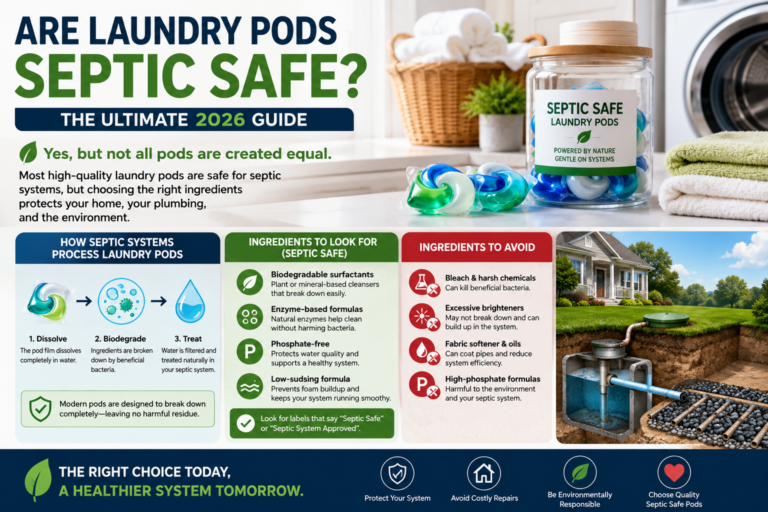
5. Are these detergents safe for septic systems?
Generally, yes. Whether you choose pods or tablets, most modern options are labeled as safe for septic systems. However, to maintain a healthy tank, look for options explicitly labeled as phosphate-free and chlorine-free.
6. Which is safer if I have toddlers in the house: Dishwasher Pods vs Tablets?
Safety is paramount. Pods are brightly colored, squishy, and look remarkably like candy, making them a high risk for accidental ingestion. Hard, chalky tablets are far less appealing to toddlers. Regardless of your Best Dishwasher Detergent 2026 choice, always store them in child-proof cabinets.
When all is said and done, picking the true winner of the Dishwasher Pods vs Tablets debate comes down to your personal household priorities. If your main goal is maximum convenience, tackling the absolute toughest baked-on grime without pre-rinsing, and experiencing flawless performance on short cycles, the modern multi-chamber pod is undoubtedly the superior piece of cleaning technology. For many, it truly is the Best Dishwasher Detergent 2026 has to offer.
On the other hand, if you are looking out for your wallet, prefer an extended shelf life without worrying about humidity, and want a tried-and-true workhorse that delivers a remarkably solid clean for just pennies a day, the classic dishwasher tablet remains an incredibly smart purchase. Assess your budget, check your home’s water hardness, and carefully consider your typical dishwashing habits. Whichever side of the Dishwashing Pacs vs Pressed Tablets aisle you choose, armed with this extensive knowledge, you are guaranteed to open your dishwasher to a brilliant, sparkling clean every single time.