-
Tel : +8613829237316
-
Email : solara@ycshinec.com

Private Label Laundry Pods: The Ultimate Guide to Launching Your Own Brand in 2026 — 7 Insider Secrets

What Are Private Label Laundry Pods?
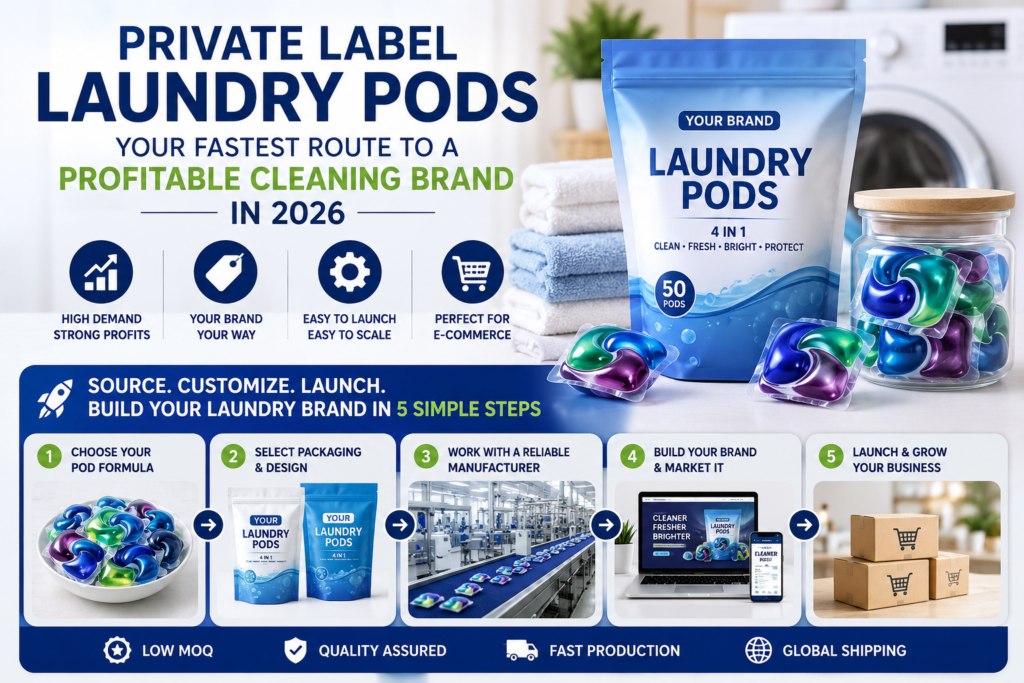
If you’ve ever picked up a store-brand laundry product and wondered how it got there, you’ve already brushed up against the concept of private label laundry pods. Simply put, private label laundry pods means you’re selling a product manufactured by a third party — but branded entirely under your own name. You control the logo, the packaging, and the positioning. The factory handles the formulation and production.
It’s one of the most efficient business models in consumer goods, and private label laundry pods are right at the center of it.
Private label laundry pods give brands of all sizes access to the same high-quality formulas used by industry giants — without the multi-million dollar investment in manufacturing equipment. Whether you’re an Amazon seller looking to escape the commodity trap, a retailer wanting to offer an exclusive product, or an entrepreneur ready to build a cleaning brand from scratch, private label laundry pods are worth a very serious look.
Private Label vs White Label vs OEM: Key Differences
These three terms get confused all the time, so let’s clear them up quickly.
| Term | What It Means | Level of Customization |
|---|---|---|
| White Label | Standard product, any brand can slap their label on it | Low — label only |
| Private Label | Product made exclusively for your brand, some formula/packaging flexibility | Medium — packaging + some formula |
| OEM (Original Equipment Manufacturer) | Fully custom product developed to your exact specifications | High — formula, weight, fragrance, packaging |
For most new brands entering the laundry pod space, private label laundry pods are the sweet spot. You get meaningful customization — fragrance, pod weight, packaging design, brand colors — without the R&D costs of a fully bespoke OEM formula. As your brand grows, you can transition to full OEM for deeper differentiation.
Why Laundry Pods Are the Hottest Private Label Category in 2026
The global laundry detergent pods market was valued at over $12 billion in 2024 and it’s growing at a compound annual rate of around 6.5%. Several trends are converging to make this the right moment to enter:
- Convenience culture — Pods eliminate measuring and mess. Consumers love them.
- Premium fragrance trend — Perfume-grade laundry pods are commanding serious price premiums, especially in North America and Europe.
- Sustainability demand — Concentrated pods use less water and packaging than liquid detergent, which resonates with eco-conscious buyers.
- Low brand loyalty — Unlike skincare or food, consumers switch laundry brands readily. A well-positioned private label can win market share fast.
Put simply, the conditions for a new private label entrant have never been better.
The Business Case for Private Label Laundry Pods
Let’s talk about numbers, because this is ultimately a business decision. The economics of private label laundry pods are genuinely attractive — but only if you go in with realistic expectations.
Market Size and Growth Potential
According to industry research from Grand View Research, the global laundry detergent market is projected to exceed $220 billion by 2030, with pods taking an increasingly large share. In the United States alone, laundry pod penetration has crossed 35% of all laundry product purchases. In the UK and Germany, the numbers are even higher.
For a private label laundry pods brand, this means you’re entering a proven, high-demand category with genuine repeat purchase potential. Unlike trend-driven products, laundry pods are a household staple — once a customer loves your brand, they’ll reorder every 4-6 weeks.
Profit Margins You Can Realistically Expect
Here’s where it gets interesting. When you source private label laundry pods directly from a China-based OEM manufacturer, your landed cost per pod can be as low as $0.08–$0.15 for a standard 20g pod and $0.12–$0.20 for a premium 25g perfume-grade pod. Retail pricing on Amazon and DTC sites for private label laundry pods typically runs $0.35–$0.80 per pod.
That’s a gross margin of 50–75% before marketing and fulfillment.
| Pod Type | Factory Cost | Retail Price | Gross Margin |
|---|---|---|---|
| Standard 20g | $0.08–$0.12 | $0.30–$0.45 | ~60–70% |
| Premium 25g Perfume | $0.15–$0.20 | $0.50–$0.80 | ~65–75% |
| Eco-Friendly Formula | $0.12–$0.18 | $0.45–$0.75 | ~60–70% |
These margins are before Amazon FBA fees or Shopify transaction costs, so your net margin will be lower — but even at 25–35% net, you’re looking at a highly viable business.
Who Is Buying Private Label Laundry Pods?
Your potential customers fall into two main groups:
B2C End Consumers — Households purchasing premium or eco-friendly laundry pods for personal use. They’re motivated by fragrance, convenience, and brand values.
B2B Buyers — Retailers, supermarket chains, hotel groups, laundry service companies, and e-commerce resellers looking to source private label laundry pods at scale. This is where the really big orders come from, and it’s the segment that China OEM factories are best equipped to serve.
How to Choose the Right Private Label Laundry Pod Manufacturer
This is the most critical decision you’ll make when launching private label laundry pods, and it’s worth taking your time. Not all manufacturers are created equal — and the difference between a reliable OEM partner and a problematic one can make or break your private label laundry pods brand before it even launches.
Key Certifications to Look For (Intertek, SGS, CE)
Certifications aren’t just nice to have — they’re essential for selling in regulated markets like the US, EU, and Australia. Here’s what to prioritize:
- Intertek certification — One of the most respected third-party testing bodies globally. Covers product safety, performance, and quality management systems.
- SGS — Another top-tier testing and certification company. SGS-certified factories have passed rigorous audits of their manufacturing processes.
- CE marking — Required for products sold in the European Union. Confirms compliance with EU health, safety, and environmental standards.
- ISO 9001 — Quality management system certification. A factory with ISO 9001 has documented, repeatable quality control processes.
- MSDS (Material Safety Data Sheet) — Essential for shipping and customs clearance. A reputable manufacturer will provide this without hesitation.
Don’t just ask for certificates — request the actual documents and verify them with the issuing body. Reputable manufacturers like Shenzhen Yucheng Daily Chemical Co., Ltd hold Intertek certification and can provide full documentation on request.
MOQ: What to Expect and How to Negotiate
MOQ — Minimum Order Quantity — is often the biggest concern for new private label laundry pods brands. Here’s the reality for private label laundry pods from China:
- Standard MOQ range: 5,000–50,000 pods per order (varies by manufacturer)
- Premium/customized formulas: MOQ tends to be higher, typically 10,000+ pods
- Packaging customization: Adding custom packaging (your own design) usually requires a minimum of 3,000–5,000 units per SKU
The good news? MOQ is almost always negotiable, especially for first orders. Manufacturers want to build long-term relationships. A few tactics that work well:
- Start with a sample order — Most factories offer sample runs of 100–500 pods for a nominal fee. Use this to validate quality before committing.
- Offer a larger second order in your negotiation — “I’ll start at X units, but if quality checks out, my second order will be Y” gives the factory confidence to lower their initial MOQ.
- Accept standard packaging for your first order — Custom packaging drives up MOQ. For your market test, stock-standard packaging with your label applied can get you to market faster and cheaper.
Red Flags to Avoid When Vetting Suppliers
The private label industry has its share of bad actors. Watch out for:
- No verifiable certifications — Any reputable factory will have documentation. If they’re vague or evasive, walk away.
- Prices that seem too good — Significantly below-market pricing usually means quality corners are being cut somewhere.
- Unwillingness to provide samples — A legitimate manufacturer will always provide samples. Refusal is a serious red flag.
- Poor communication response times — If a factory takes days to respond during the sales process, imagine how they’ll respond when there’s a production problem.
- No factory audit option — Established factories welcome third-party audits. If they resist, that tells you something.
Customization Options for Your Private Label Brand
One of the biggest advantages of working with a quality OEM manufacturer for private label laundry pods is the depth of customization available. You’re not just putting your logo on someone else’s product — you’re building private label laundry pods that genuinely reflect your brand.
Formula Customization: Weight, Fragrance, and Function
The formula is where you can create real differentiation. Key variables include:
Pod weight:
- 20g — Standard weight, suitable for regular loads. More cost-effective, ideal for value-positioning.
- 25g — Heavy-duty weight, more concentrated formula. Commands a premium price and signals quality to buyers.
Fragrance options:
- Standard fragrance (commercial-grade): Fresh, floral, and clean scents at accessible price points
- Perfume-grade fragrance: High-concentration, long-lasting scent profiles (lavender, ocean breeze, cedar, rose) that replicate luxury perfume experiences
- Fragrance-free: Growing demand from sensitive-skin and allergy-conscious consumers
Functional formulas:
- Standard cleaning
- Anti-bacterial
- Color-protect
- Sensitive skin (hypoallergenic, dermatologist-tested)
- Eco-friendly (biodegradable, plant-based surfactants)
- 3-in-1 (wash + fabric softener + stain remover)
Packaging Design: Bags, Boxes, and Eco-Friendly Options
Packaging is your silent salesperson. It’s the first thing a customer sees, and in a competitive retail environment, it can be the deciding factor in a purchase. Your options include:
| Package Type | Best For | Notes |
|---|---|---|
| Flexible pouch (stand-up bag) | Amazon, DTC | Cost-effective, good shelf presence |
| Rigid box | Retail, premium positioning | Higher cost, excellent brand image |
| Refill pouch | Eco-conscious brands | Reduces plastic, lower material cost |
| Bulk bag | B2B, wholesale | Maximizes cost efficiency |
Most manufacturers offer full custom printing on packaging with a minimum run. Work with a designer to create packaging that communicates your brand values clearly and stands out in your target channel.
Private Label Branding: Logo, Color, and Label Design
Your brand identity on the product needs to work hard. A few principles that the best private label laundry brands follow:
- Color psychology matters — Blues and whites communicate cleanliness and trust. Greens signal eco-friendliness. Black and gold convey premium positioning.
- Keep the front panel clean — The key information (pod count, fragrance, key benefit) should be immediately readable at a glance.
- Certifications on pack — If your product has SGS, Intertek, or other certifications, put the badges on the packaging. They build instant trust.
- QR code to your website — A simple addition that drives traffic and builds your direct relationship with the end consumer.
Step-by-Step Process: From Idea to Finished Product
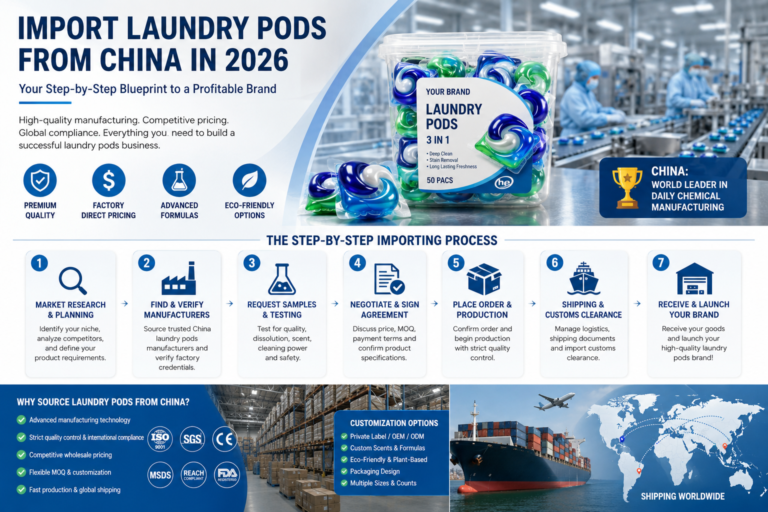
Here’s the complete roadmap, broken down into seven clear steps.
Step 1 — Define Your Target Market and Product Positioning
Before you contact a single manufacturer, you need clarity on who you’re selling to and what you’re promising them. Answer these questions:
- Who is your ideal customer? (B2C household, B2B retailer, hotel chain?)
- What problem are you solving? (Convenience, fragrance, eco-friendliness, price?)
- Where will you sell? (Amazon, Shopify, retail, wholesale?)
- What price point will you target?
Your answers will determine every subsequent decision — from formula choice to packaging to MOQ.
Step 2 — Find and Vet Your Manufacturer
Use a combination of Alibaba.com, trade shows (Canton Fair, China Clean Expo), and direct referrals to build a shortlist of 3–5 manufacturers. Vet each one against the criteria in Section 3: certifications, MOQ flexibility, communication quality, and audit willingness.
Step 3 — Request Samples and Test Quality
Request samples from your top 2–3 candidates. Test them rigorously:
- Dissolution rate in cold and hot water
- Cleaning performance on common stains (oil, wine, grass)
- Fragrance intensity and longevity (immediately after wash and 24 hours later)
- Pod integrity (does it dissolve completely without leaving residue?)
- Packaging quality and print accuracy
Step 4 — Negotiate Pricing, MOQ, and Lead Time
Once you’ve selected your preferred manufacturer, negotiate the commercial terms. Key points to cover:
- Unit price at your target volume
- MOQ for initial order and repeat orders
- Sample cost and whether it’s credited against first order
- Production lead time (typically 15–30 days for standard orders)
- Payment terms (30% deposit, 70% before shipment is standard)
Step 5 — Finalize Packaging and Branding
Work with a designer to create your packaging artwork. Submit to the manufacturer for their approval and pre-production proof. Review the proof carefully — check colors, text accuracy, barcode functionality, and certification logos.
Step 6 — Place Your First Order and Arrange Shipping
Once the pre-production proof is approved, place your order and pay the deposit. Arrange shipping via your preferred freight forwarder. For orders under 1 CBM, air freight may be cost-effective. For larger orders, sea freight is significantly cheaper — budget 25–40 days from production completion to your warehouse.
Step 7 — Launch and Scale
With product in hand, you’re ready to launch. Build your Amazon listing or Shopify store, run initial promotions to generate reviews and velocity, and start building your customer base. Reinvest early profits into your next, larger production run.
Cost Breakdown: How Much Does It Cost to Start?
Many entrepreneurs overestimate what it costs to launch private label laundry pods. Here’s a realistic cost breakdown for your first private label laundry pods starter order:
Sample Costs
- Factory sample fee: $50–$150 (often refunded against first order)
- International shipping for samples: $30–$80
Production Costs per Unit
- Standard 20g pods (10,000 unit order): $0.08–$0.12 per pod
- Premium 25g perfume pods (10,000 unit order): $0.15–$0.20 per pod
- Custom packaging setup fee (one-time): $200–$500
- Custom packaging per unit (pouch): $0.05–$0.12
Shipping and Import Duties
- Sea freight (China to US, 1 CBM): approximately $150–$300
- Import duties (US HTS for laundry preparations): typically 3.7–6%
- Customs broker fee: $100–$200
Estimated total investment for a starter order of 10,000 pods:
| Item | Estimated Cost |
|---|---|
| Product (10,000 x $0.18 average) | $1,800 |
| Custom packaging setup | $350 |
| Packaging per unit ($0.08 x 10,000) | $800 |
| Sea freight + duties | $500 |
| Samples and testing | $150 |
| Total | ~$3,600 |
At a retail price of $0.50 per pod, 10,000 pods generates $5,000 in revenue — a gross profit of approximately $1,400 on your first run, with margins improving significantly on repeat orders as setup costs disappear.
Selling Your Private Label Laundry Pods: Best Channels
Amazon FBA
Amazon remains the most powerful launch platform for private label laundry pods. The FBA model handles warehousing, shipping, and customer service — you focus on marketing and inventory management. Budget for PPC advertising (Sponsored Products) in your first 90 days to build ranking and reviews for your private label laundry pods listing.
Shopify and DTC
A direct-to-consumer Shopify store gives you full margin and full customer data. It’s slower to build than Amazon but creates a more defensible brand asset over time. Email marketing, subscription models, and social media are your key growth levers here.
Wholesale and Retail Distribution
Once your brand has proven itself online, wholesale opens up. Approach regional grocery chains, specialty cleaning retailers, and hotel procurement managers. This channel offers lower margins but much higher volume and brand visibility.
6 FAQs About Private Label Laundry Pods
Q1: What is the minimum order quantity for private label laundry pods from China?
Most reputable manufacturers offer MOQs starting at 5,000 pods for standard formulas. Custom fragrance or specialized formulas may require 10,000+ pods. MOQ is negotiable — don’t be afraid to ask, especially for your first order.
Q2: How long does it take to get my first private label laundry pods order?
From finalizing your formula and packaging to receiving your private label laundry pods, budget 45–70 days. This includes production (15–30 days), quality inspection (3–5 days), and sea freight to your destination (25–40 days depending on destination port).
Q3: Do I need my own formula, or can I use the manufacturer’s standard formula?
You don’t need your own formula to start. Most manufacturers offer a range of pre-developed formulas you can brand under your name. As your brand grows, you can invest in custom formula development for deeper differentiation.
Q4: What certifications do my private label laundry pods need?
This depends on your target market. For the US, MSDS documentation and compliance with EPA Safer Choice guidelines are important. For the EU, CE marking and REACH compliance are required. Always confirm certification requirements with your manufacturer and a local regulatory consultant.
Q5: Can I get eco-friendly or biodegradable private label laundry pods?
Yes. Many China OEM manufacturers now offer private label laundry pods with biodegradable, plant-based surfactant formulas and water-soluble PVA film that are environmentally certified. These eco-friendly private label laundry pods command a premium price point and are in high demand in North America and Europe.
Q6: How do I protect my brand formula and packaging from being copied?
Register your trademark in your target markets before launching. Use a Non-Disclosure Agreement (NDA) with your manufacturer. Work with established, reputable factories — they have reputational skin in the game and are less likely to engage in IP theft than smaller, anonymous suppliers.
Conclusion
Private label laundry pods represent one of the most accessible and profitable entry points into the consumer goods market in 2026. The formula is straightforward: find a certified, reputable OEM manufacturer, customize private label laundry pods that genuinely meet your target customer’s needs, build a brand identity that stands out, and execute a disciplined launch strategy.
The barriers to entry are lower than most people think. With a realistic starting investment of $3,000–$5,000, you can have professional private label laundry pods in the market within 60–90 days. The margins are attractive, the repeat purchase cycle is strong, and the global demand for private label laundry pods is only growing.
If you’re ready to explore private label laundry pod manufacturing with a certified, experienced OEM partner, Shenzhen Yucheng Daily Chemical Co., Ltd offers Intertek-certified production, 25g high-weight perfume-grade formulas, and flexible MOQ for brands at every stage of growth. Contact us to request samples and a custom quote.
*Sources: Grand View Research, Global Laundry Detergent Market Report 2024; Statista, Laundry Care Market Data 2025; EPA Safer Choice Program.