Leave A Message
Tips: Kindly notice that reply of inquiry via email may went into spam, please kindly check your spam if you have sent inquiry email and do not receive replies, thank you.

Buyers comparing perfume-grade laundry pods should use one written specification for every supplier. The specification should identify the formula direction, unit format, package, target market, test conditions and acceptance criteria.
The approved perfume-grade laundry pods sample should have a code and date. Before ordering perfume-grade laundry pods, confirm that the quotation, artwork and test evidence refer to that same version. For perfume-grade laundry pods projects, any later formula, fragrance, film or packaging change should require written buyer approval.
perfume-grade laundry pods should be specified through a written fragrance brief, formula compatibility review and repeatable wash testing. The term describes a premium scent-development direction; it should not be treated as a universal certification or an unsupported performance guarantee.
When comparing perfume-grade laundry pods, record the fragrance family, note structure, concentration basis, delivery system, wet and dry fabric profile, stability conditions and packaging barrier. Approve a coded sample and keep the evidence tied to the final formula.
For product-safety context, review the official CPSC liquid laundry packet guidance. Market requirements and claim evidence must still be confirmed for the exact formula, package and destination.
Perfume-grade laundry pods are developed for brands that want fragrance to be a central part of the laundry experience. The term usually describes a refined scent concept, deliberate note structure, controlled fragrance performance, and premium positioning. It is not a single legal grade, certification, or fixed fragrance percentage.
For an OEM/ODM buyer, the useful question is not whether a supplier uses the phrase “perfume-grade.” The useful question is whether the fragrance brief, detergent formula, water-soluble film, sample tests, safety documents, packaging, and finished-product claims work together for the destination market.

“Perfume-grade” is a commercial product-development term rather than a universal detergent standard. Different suppliers may use it differently. A serious buyer should translate the term into measurable requirements instead of accepting it as proof of quality.
A multi-note fragrance can support premium positioning, but top, heart, and base-note language alone does not prove wash performance. The finished pod must be evaluated before washing, during the wash, after drying, and during storage.
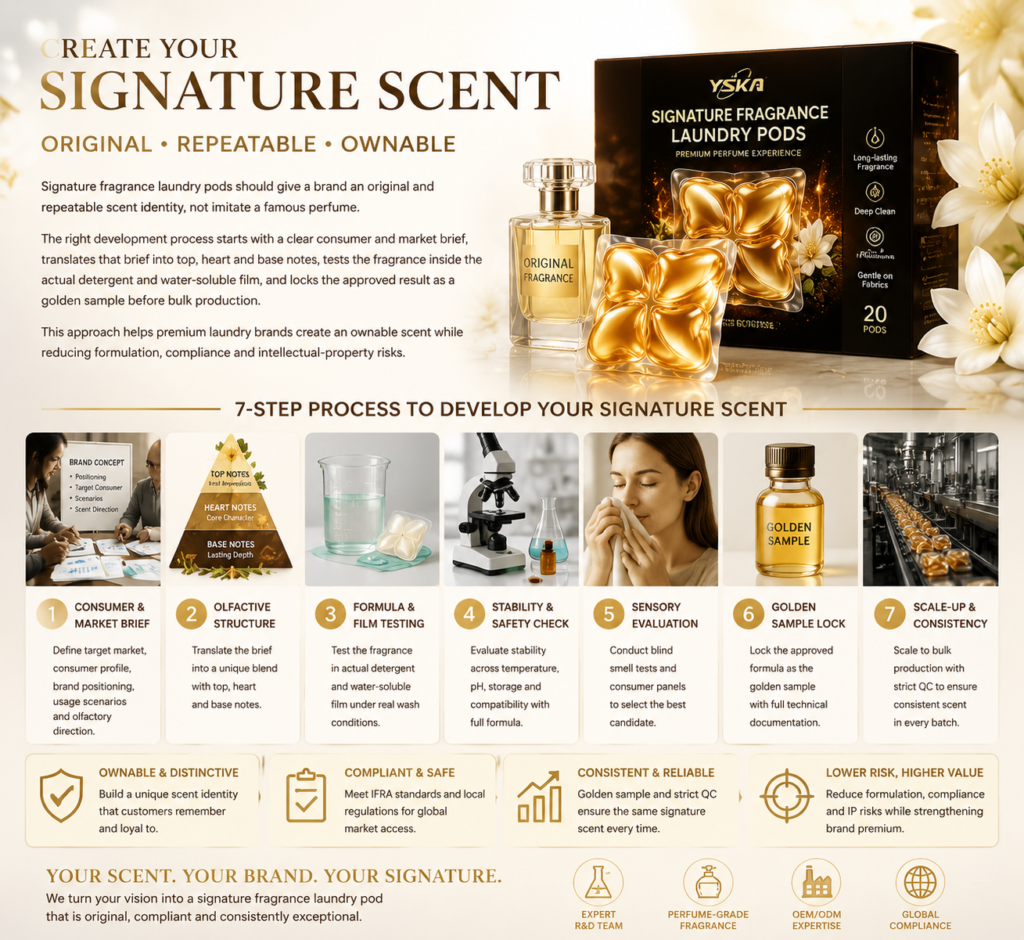
A fragrance brief gives the perfumer and detergent manufacturer a shared target. Begin with the brand concept, destination market, customer, desired emotional impression, reference families, notes to include or avoid, intensity target, drying method, and expected retail position.
| Brief Item | Buyer Decision |
|---|---|
| Brand mood | Clean, elegant, warm, botanical, modern, or another defined direction |
| Scent family | Floral, citrus, woody, amber, musk, aromatic, gourmand, or a blend |
| Wash conditions | Target water temperature, machine type, cycle, dose, and fabric mix |
| Drying method | Line drying, tumble drying, or both |
| Intensity | Desired perception in the package, wet laundry, dry fabric, and storage |
| Restrictions | Market-specific ingredient, allergen, claim, or brand requirements |
Use reference fragrances to communicate direction, not to request an unauthorized copy of another brand’s protected identity. A manufacturer can create an original fragrance within the desired family and commercial positioning. For the broader creative process, read our custom scent development guide.
A fragrance that smells attractive on a blotter may behave differently inside a concentrated detergent. Surfactants, enzymes, solvents, builders, colorants, water content, pH, and storage conditions can change scent perception or stability. The fragrance can also affect pod appearance, viscosity, seals, or water-soluble film performance.
Do not set a universal fragrance percentage from an online article. The appropriate level depends on the fragrance mixture, formula, intended use, supplier guidance, applicable restrictions, performance target, and test results. More fragrance does not automatically mean better retention and may create unwanted odor, stability, cost, or compatibility problems.
Claims such as “long-lasting” or a fixed number of hours require a defined method and evidence. Results vary with fabric, dose, machine, water, cycle, detergent load, drying method, storage, climate, and the people evaluating the scent.
The test plan should be agreed before the buyer makes a retention claim. Our article on what long-lasting laundry fragrance really means explains why a headline duration cannot be separated from test conditions.
Ask for documentation that matches the fragrance mixture and finished formula being purchased. Depending on the project and market, this may include the product specification, Safety Data Sheet, ingredient or allergen information, fragrance supplier documentation, test reports, stability records, and declarations needed for the final label.
The IFRA Standards can restrict, prohibit, or set criteria for certain fragrance materials. IFRA also explains that its standards do not replace national or local legal requirements. An IFRA Certificate of Conformity is established by the company creating the fragrance mixture for an intended use; IFRA itself does not certify the finished laundry pod.
Buyers should therefore avoid vague claims such as “IFRA certified product.” Ask who issued the document, which fragrance code and intended use it covers, which amendment or standard basis applies, and whether the finished product still requires additional regulatory review.
A fragrance sample in a bottle is not the finished product. Approve the scent inside the intended detergent formula, film, chamber design, color, pod weight, and package. Evaluate cleaning, dissolution, residue, leakage, seal strength, fragrance, appearance, package closure, and storage together.
Keep a signed reference sample and final written specification with both buyer and manufacturer. Record the fragrance supplier code, approved dosage or range, formula version, pod structure, package materials, artwork version, and acceptance criteria. Follow the 15-point sample testing checklist before bulk production.
Premium packaging should communicate the scent family clearly without sacrificing moisture protection, closure performance, warnings, directions, batch coding, ingredient information, and required languages. Test the actual pods inside the proposed bag, tub, or box because package materials and headspace can affect the opening experience and storage performance.
Use a consistent collection system for scent names, colors, descriptions, and pack hierarchy. Avoid implying affiliation with a luxury perfume house unless authorized. Every front-panel benefit should match the approved product and available evidence.
The purchase order and quality plan should reference the approved sample, fragrance code, formula version, pod weight tolerance, chambers, film, package specification, artwork, quantity, batch coding, inspection method, and required documents. Pre-shipment inspection should check both physical quality and consistency with the approved reference.
No universal certification defines a laundry pod as perfume-grade. Buyers should convert the positioning term into a written scent brief, product specification, supplier documents, test plan, and acceptance criteria.
No. Retention depends on the fragrance system, formula, fabric, wash and drying conditions, storage, and test method. A higher level may also affect stability, film compatibility, odor balance, or cost.
Yes, when the project includes a clear brief, suitable fragrance-development support, sample revisions, compatibility checks, documentation, and final approval criteria. Ownership and exclusivity terms should be agreed in writing.
The strongest perfume-grade laundry pods project is not built on a label or a universal dosage claim. It is built on a precise brief, compatible formula, controlled testing, correct documents, safe packaging, and repeatable production.
To develop a private-label fragrance collection, contact SHINEC with your destination market, scent direction, pod specification, pack count, expected quantity, and launch schedule.
The following SHINEC factory images provide production, laboratory and quality-control context. Buyers should still verify the exact line, sample and document scope for their selected product.