Leave A Message
Tips: Kindly notice that reply of inquiry via email may went into spam, please kindly check your spam if you have sent inquiry email and do not receive replies, thank you.

Follow the laundry pods OEM process from product brief and feasibility review through samples, packaging, quality control and mass production.
Launching a private-label laundry pod is not simply a matter of choosing a color, adding a fragrance, and printing a logo. A reliable laundry pods OEM process connects the commercial idea to a controlled formula, a compatible water-soluble film, compliant packaging, an approved sample, and repeatable mass production.
In short, the process has eight steps: define the product brief, review technical feasibility, develop the formula and fragrance, confirm packaging, test samples, approve the commercial order, manufacture under quality controls, and release the finished goods. Each step should create a written output that becomes the input for the next one.
This guide explains what buyers should decide, what the manufacturer should verify, and which records should be approved before production starts. It is written for brand owners, importers, distributors, retailers, and sourcing teams developing private-label or OEM/ODM laundry pods.
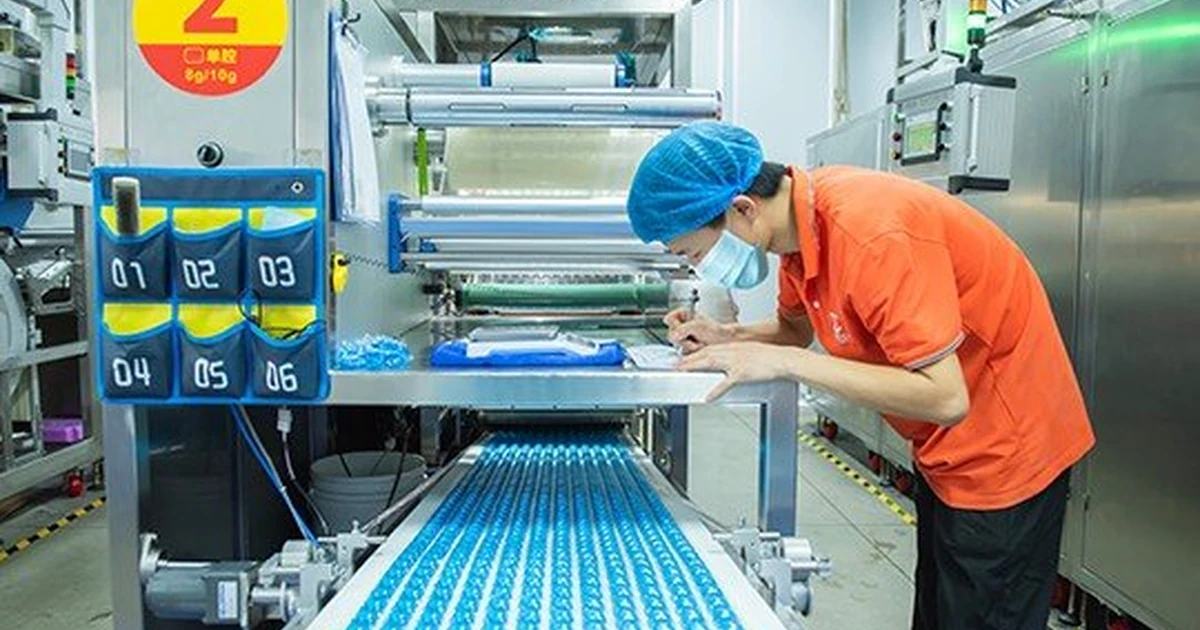
Watch this short SHINEC video for a quick look at our laundry pod manufacturing content:
Watch the SHINEC laundry pod video on YouTube.
A useful product brief does not need to contain a complete chemical formula. However, it should tell the manufacturer what the product must do, where it will be sold, and how it will be positioned.
Prepare the following information before requesting samples:
| Brief item | Questions to answer |
|---|---|
| Target market | Which country or region will receive the product? |
| Customer and channel | Is it for supermarkets, e-commerce, distributors, hotels, laundromats, or another channel? |
| Product position | Standard cleaning, premium fragrance, concentrated formula, low-foam, value range, or another position? |
| Pod format | Desired weight, chamber count, shape, color, and suggested laundry load? |
| Fragrance | Floral, fruity, fresh, woody, amber, vanilla, or a supplied reference? |
| Packaging | Tub, pouch, paper box, pack count, label language, and case quantity? |
| Claims | Which cleaning, fragrance, environmental, safety, or certification statements are planned? |
| Commercial target | Expected order quantity, launch date, destination port, and preferred trade term? |
The brief should separate three kinds of requirements: must-have, preferred, and open to recommendation. This prevents the project from stalling because every small preference is treated as non-negotiable.
The first step in the laundry pods OEM process is converting a marketing idea into measurable product requirements. “We want a luxury laundry pod” is a starting point, but it is not yet a manufacturing instruction.
Start with the intended washing habits. A pod for small household loads may need a different unit dose from a pod designed for larger machines. A low-foam formula may be preferred for many front-loading applications, while the final formula should still be validated against the machines, water conditions, wash programs, and laundry loads expected in the target market.
The buyer should also define whether the product is mainly expected to deliver everyday cleaning, premium fragrance, stain-focused performance, fabric care, or a balance of these benefits. A single product cannot be optimized for every claim without trade-offs.
Premium positioning can affect several physical decisions:
For example, SHINEC supports OEM/ODM development across formula, fragrance, color, shape, chamber design, and packaging. Available formats should be evaluated against the actual project rather than selected by appearance alone. You can review common options in this guide to private-label laundry pods.
Give the brief a version number and date. If a fragrance, dose, pack count, or target market changes later, record the revision. Version control sounds formal, but it prevents a familiar problem: the buyer approves one sample while the packaging team designs for another specification.
Output of Step 1: an approved product brief containing the target market, formula direction, pod format, fragrance direction, packaging concept, planned claims, expected volume, and project responsibilities.
Once the brief is received, the manufacturer should check whether all requirements can work together. This stage of the laundry pods OEM process is where attractive ideas meet technical limits, regulatory obligations, tooling requirements, and order economics.
Laundry pods depend on compatibility between the concentrated liquid and the water-soluble film. The formula must remain stable in the selected chamber structure, while the film must survive normal filling, sealing, handling, storage, and transport before dissolving during use.
The technical review should consider:
A proposed pod with too much liquid for its geometry may look good in a rendering but create sealing or pressure problems in production. Likewise, changing fragrance concentration can affect more than scent; it may require another stability and compatibility review.
MOQ is not one universal number. It may depend on whether the buyer selects an existing mold or requests a new shape, uses a stock fragrance or custom development, chooses standard packaging or fully customized printed materials, and orders one or several variants.
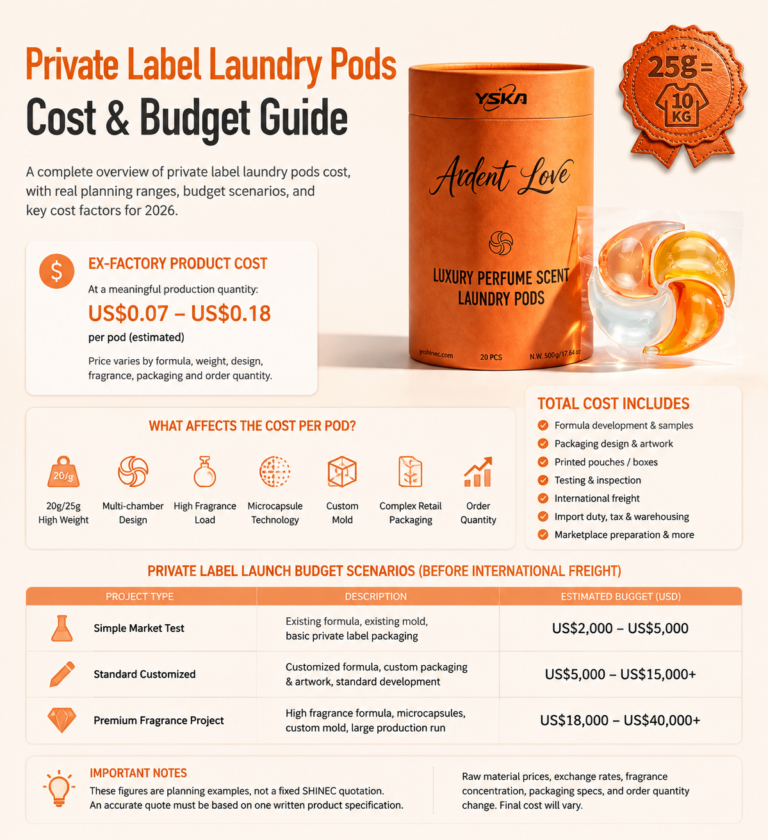
Cost is also shaped by unit weight, chamber count, formula level, fragrance system, film, pack count, packaging material, testing, and order volume. Buyers can use this private-label laundry pod cost guide and the explanation of laundry pod OEM MOQ to prepare better questions. Final MOQ, price, inventory status, and lead time should still be confirmed for the current project.
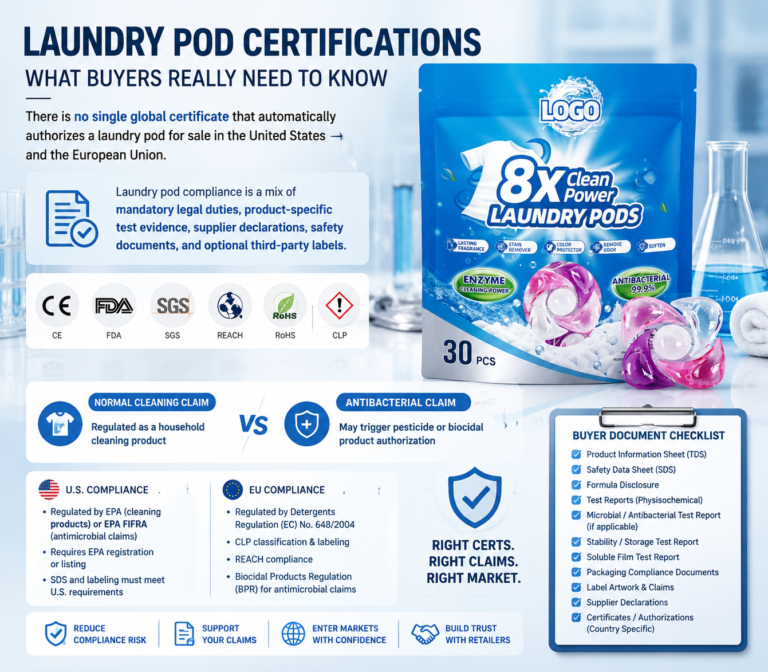
Compliance must begin before artwork approval, not after the finished product reaches the warehouse. The target market and planned claims determine what classification, labeling, packaging, product-safety, chemical, and importer obligations may apply.
For the United States, the U.S. Consumer Product Safety Commission identifies ASTM F3159 as the voluntary safety standard associated with liquid laundry packets. Buyers should review current applicability with qualified advisers and their U.S. responsible parties. The official CPSC liquid laundry packet page is a useful starting point.
For the European Union, Commission Regulation (EU) No 1297/2014 added specific requirements for liquid consumer laundry detergents in soluble single-use packaging, including provisions affecting outer packaging and soluble packets. The official text is available through EUR-Lex.
These links are not a substitute for a market-specific legal review. Formula, hazards, claims, language, pack type, sales channel, and importer role can change the required work.
Output of Step 2: a feasibility report or written project confirmation covering the proposed specification, available options, development work, test plan, estimated commercial basis, and unresolved risks.
The third step turns the approved direction into sample-ready specifications. This part of the laundry pods OEM process usually requires the closest collaboration between the buyer, formulator, fragrance supplier, packaging team, and production engineer.
The formula brief should define the intended performance level and use conditions without relying only on adjectives such as “strong” or “eco.” Useful requirements include the target laundry load, wash temperature range, foam direction, fabric types, stain priorities, fragrance intensity, and any ingredient restrictions required by the buyer or market.
If an environmental label is a commercial objective, it should be treated as a separate qualification project. For example, the U.S. EPA Safer Choice Standard evaluates products and their ingredients against program criteria. A manufacturer should not place the Safer Choice label on a product merely because individual ingredients appear acceptable; the product must complete the applicable program process.
For premium scented laundry care, a fragrance name is not enough. The brief should specify:
Use descriptive, original fragrance positioning rather than implying unauthorized association with a named luxury house. “Woody amber with bergamot and soft musk” is clearer and safer than claiming an identical copy of a third-party perfume.
The chamber structure must support both visual design and manufacturing reliability. Multi-chamber pods can separate components or create a distinctive shelf appearance, but the selected geometry, fill distribution, and formula must be proven together.
At this stage, confirm:
Do not publish “active ingredient” percentages, cleaning multipliers, fixed fragrance duration, or other performance claims until the definition and evidence are matched to the exact formula and test method.
Output of Step 3: a controlled development specification for the formula, fragrance, pod geometry, unit weight, color, fill allocation, and sample version.
Packaging is not decoration added at the end of the laundry pods OEM process. It helps protect moisture-sensitive pods, carries mandatory information, supports safe storage, and influences logistics cost and shelf presentation.
Common options include plastic tubs, stand-up pouches, and paper boxes with suitable inner protection. The final choice should consider:
The package shown in a supplier catalog may not automatically meet every target-market requirement. Confirm the exact closure, material, barrier, warning layout, and testing required for the approved destination.
Artwork development should use a controlled checklist. It may need the product name, net contents, use directions, dosage, warnings, storage instructions, ingredient or disclosure information, responsible-party details, batch coding area, barcode, country-of-origin statement, and market-specific hazard elements.
Claims deserve special attention. “Biodegradable,” “non-toxic,” “hypoallergenic,” “antibacterial,” “safe for babies,” or “72-hour fragrance” should not be added because they sound attractive. Each claim needs a clear definition, relevant evidence, and a legal review for the market where it will appear.
Color on a monitor can differ from printed packaging. Approve artwork content digitally, then approve a physical color standard, print proof, material sample, or production reference where appropriate. Record the barcode and all variable fields before the print run.
Output of Step 4: approved artwork, packaging material specification, pack count, carton configuration, barcode data, coding position, and required packaging test plan.
Samples are the decision gate between development and commercial commitment. A sample that smells good on the day it arrives is not enough. The laundry pods OEM process should evaluate the pod, its packaging, and the proposed claims under defined conditions.
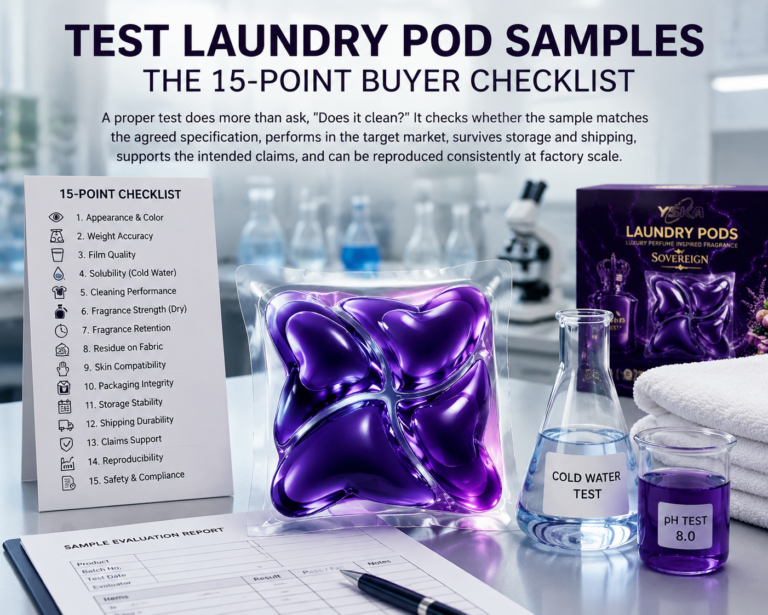
Buyers should record results instead of approving by memory. A practical evaluation covers:
| Area | What to check |
|---|---|
| Appearance | Shape, chamber definition, color, bubbles, contamination, and visible defects |
| Weight | Individual pod weight and consistency across the sample set |
| Seal integrity | Leakage, weak seals, deformation, and handling resistance |
| Film behavior | Storage condition, dissolution behavior, and residue under defined wash conditions |
| Cleaning | Performance on selected fabrics and stains using a repeatable method |
| Foam | Suitability for the target machine and wash cycle |
| Fragrance | Pod scent, wet-fabric scent, dry-fabric scent, and change over time |
| Packaging | Closure, moisture protection, label accuracy, drop resistance, and pack count |
| Documentation | Formula/sample code, specification, SDS/MSDS, COA plan, and test scope |
Our detailed 15-point laundry pod sample checklist explains how buyers can compare samples before bulk production.
Early samples are for choosing directions. The golden sample is the final approved reference for mass production. It should correspond to a defined formula version, fragrance version, unit weight, pod structure, color, and packaging specification.
Approval should be written. Statements such as “sample two is fine” are risky when several formula and fragrance variants have been shipped. Use a sample code, approval date, photos, and signed or emailed confirmation.
Test reports do not automatically transfer from one formula to another. A report should be checked against the product name, submitted sample, formula or batch, test method, date, and scope. If the buyer changes fragrance, concentration, pod weight, film, or packaging after testing, the project team should decide whether re-evaluation is necessary.
SHINEC’s available quality workflow includes incoming-material checks, pre-production sample confirmation, in-process inspection, outgoing inspection, and batch traceability. The laboratory includes washing, dishwashing, environmental, and stability-testing equipment. Bulk-order reference samples are retained for three years. These controls support consistency, but each customer project still needs its own approved specification and test plan.
Output of Step 5: an approved golden sample, completed evaluation record, test results for the defined scope, and a signed sample/specification release.
After sample approval, commercial and technical records must be aligned. This is the point in the laundry pods OEM process where informal development decisions become purchasing and production instructions.
The purchase agreement or pro forma invoice should identify:
EXW, FOB, CIF, or DDP may be available depending on the order, but responsibilities and current quotations must be confirmed case by case.
Before materials are ordered, lock the formula, fragrance, film, pod weight, chamber layout, color, package, artwork, carton, coding, and quality criteria. Any later change should go through a written change-control process.
This is important because one “small” change can affect several departments. Increasing fragrance may require stability review. Changing pack count changes packaging dimensions and carton loading. Replacing a pouch with a tub affects material procurement, freight volume, labeling area, and potentially safety requirements.
When production materials differ from development materials, request a pre-production sample or line trial using the approved components. Compare it with the golden sample before authorizing the full run.
Output of Step 6: confirmed order, frozen master specification, approved artwork files, quality agreement, inspection criteria, and production release authorization.
Mass production should reproduce the approved standard at scale. A robust laundry pods OEM process controls materials, equipment settings, pod formation, filling, sealing, packaging, and records throughout the run.
Relevant incoming checks may cover concentrated raw materials, fragrance, water-soluble film, colorants, tubs or pouches, labels, cartons, and printed components. The inspection plan should define what is checked, the acceptance criteria, and what happens when a material does not conform.
Printed packaging deserves its own review because a correct pod in an incorrect package can still make the shipment unusable. Verify version number, language, barcode, color reference, warnings, quantity, and material specification.
During forming and filling, the production team should monitor items such as:
The production record should connect the finished product to the raw-material batches, formula batch, line, date, shift, and packaging materials used.
Packing checks can include pod count, container closure, label position, code legibility, carton quantity, sealing, gross weight, and shipping marks. Where required, conduct package drop, compression, or transport-related checks under the agreed protocol.
The buyer and manufacturer should agree whether inspection is performed by the factory, the buyer, or an independent third party. The inspection standard, sampling level, and defect definitions should be decided before the inspector arrives.
Output of Step 7: batch manufacturing record, in-process inspection records, packaging records, deviation reports where applicable, and finished-goods inspection results.
Production is not complete when the last carton leaves the line. The final step of the laundry pods OEM process confirms that the finished batch meets the agreed release criteria and that documents match the actual goods.
Before release, review the finished product against the approved specification and golden sample. Depending on the project, the release file may include:
Different documents prove different things. A COA reports defined batch or product characteristics. An SDS communicates hazard and handling information. A REACH screening report addresses the substances and scope tested. A transport appraisal concerns transport classification under its stated conditions. One document should not be presented as a universal certificate for every market.
For a clearer explanation, read What Certifications Do Laundry Pods Need?.
Laundry pods are sensitive to moisture and unsuitable storage conditions. Confirm container loading, carton protection, storage instructions, and shipment timing. The packaging system should be evaluated for the expected transport route and climate rather than only for appearance on a retail shelf.
Retain the approved specification, artwork, test reports, batch records, inspection results, shipment documents, and reference samples according to the agreed retention system. If a distributor later reports leakage, scent variation, or packaging damage, the team can investigate the correct batch instead of guessing.
At SHINEC, retained samples for bulk orders are kept for three years as part of the batch traceability process. The company has 10+ years of industry experience, over 10 production lines, eight technical development engineers, and a laboratory of more than 300 square meters. Buyers can learn more about evaluating an OEM laundry pod factory in China.
Output of Step 8: signed batch release, complete shipment documents, traceable batch records, retained samples, and a post-shipment issue-handling process.
Before authorizing mass production, confirm that every item below has a clear “yes”:
If one of these items remains open, do not assume the production team will resolve it in the way the brand expects. Close the issue in writing.
A new fragrance or packaging structure may require renewed testing, quotations, and material purchasing. Control changes instead of treating them as simple design edits.
Fragrance in the container, on wet laundry, and on dry fabric can smell different. Evaluate it through the intended wash and drying process.
Premature printing can lock in unsupported claims, missing warnings, or incorrect responsible-party information. Finalize regulatory and technical review first.
No single document replaces formula classification, labeling, packaging, importer duties, and country-specific obligations. Match each document to its exact scope.
Two quotations may cover different pod weights, formulas, fragrance systems, film, packaging, test plans, or inspection levels. Compare the complete specification, not only the unit price.
There is no responsible universal lead time. Timing depends on formula development, fragrance revisions, pod tooling, packaging availability, testing, artwork approval, order quantity, and destination requirements. A repeat order using approved materials is usually simpler than a new custom formula and package. Request a project schedule after the brief is reviewed.
MOQ depends on the selected pod format, formula, fragrance, number of variants, printed packaging, and material suppliers. Existing formats and packaging may have a different commercial threshold from new molds or fully customized materials. Confirm the current MOQ for the exact specification rather than relying on a general website number.
Yes. A reference can help communicate the desired family, mood, and note structure. The development target should be described and named independently, without suggesting unauthorized affiliation with the referenced brand. The final fragrance must also be reviewed for formula compatibility and target-market requirements.
Approve the golden sample, formula and fragrance versions, pod weight and structure, color, film, packaging materials, artwork, barcode, carton specification, inspection criteria, required documents, and commercial terms. These items should appear in a frozen master specification or equivalent controlled record.
The test plan may include appearance, weight consistency, seal integrity, pressure or handling resistance, film behavior, dissolution under defined conditions, leakage, cleaning, foam, fragrance, stability, packaging, and transport-related checks. The exact plan should reflect the formula, package, claims, and destination market.
Not automatically. Check the report’s sample name, formulation or batch, weight, film, packaging, method, date, and test scope. A material, fragrance, concentration, or format change may require a technical assessment or new testing.
Many OEM/ODM suppliers can support dielines, label layout, packaging options, and print coordination. However, the brand owner and responsible market operator should still approve trademarks, claims, translations, warnings, barcodes, and legal information before printing.
Not every project uses the same pilot-batch structure, but a pre-production sample or line trial is valuable when the formula, film, chamber design, or packaging is new. It helps confirm that the approved laboratory direction can be reproduced with production materials and equipment.
A successful laundry pods OEM process is a chain of controlled decisions. The product brief defines the target. Feasibility review identifies risks. Development converts the idea into a formula and pod specification. Packaging engineering protects the product and carries required information. Sample testing creates evidence. Specification freeze prevents late confusion. Production controls repeat the approved standard, and batch release protects traceability after shipment.
The most important buyer habit is simple: approve every critical decision in writing and connect every claim to the correct sample, test, and market. That approach reduces rework, avoids packaging mistakes, and gives the manufacturer a clear standard to reproduce.
SHINEC provides OEM/ODM and private-label development for premium fragrance laundry pods, including formula, fragrance, color, chamber design, packaging, sample evaluation, and production support. To discuss a new project, contact solara@ycshinec.com or visit ycshinec.com.