Leave A Message
Tips: Kindly notice that reply of inquiry via email may went into spam, please kindly check your spam if you have sent inquiry email and do not receive replies, thank you.

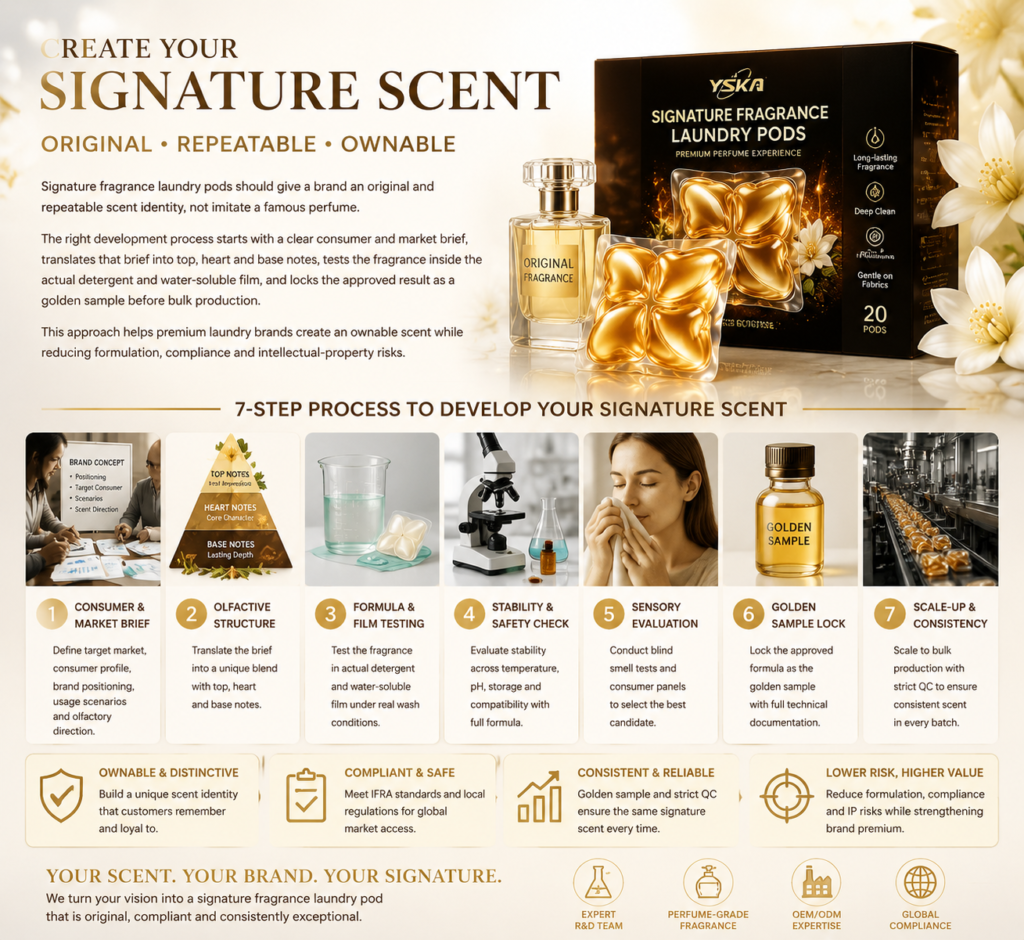
Signature fragrance laundry pods should give a brand an original and repeatable scent identity, not imitate a famous perfume. The right development process starts with a clear consumer and market brief, translates that brief into top, heart and base notes, tests the fragrance inside the actual detergent and water-soluble film, and locks the approved result as a golden sample before bulk production. This approach helps premium laundry brands create an ownable scent while reducing formulation, compliance and intellectual-property risks.
A fragrance can make a laundry product memorable, but a familiar luxury name is not a shortcut to a defensible brand. A scent that works beautifully in alcohol-based perfume may change inside a concentrated detergent, disappear during rinsing or interfere with formula stability. At the same time, copied names, similar packaging or advertising that suggests another brand’s authorization may create avoidable legal and commercial problems.
This guide explains a practical seven-step process for developing an original signature scent for OEM/ODM laundry pods. It focuses on the decisions buyers need to make, the evidence they should request and the controls that help the approved fragrance remain consistent in mass production.
Signature fragrance laundry pods are pre-measured detergent capsules developed around a distinctive scent profile that a customer can associate with one laundry brand. Instead of using only a generic lemon, floral or “fresh” fragrance, the product is designed with a recognizable scent architecture and a defined emotional idea.
A signature scent may open with bergamot and green leaves, move into rose and tea, and settle into clean musk and cedar. Another may use pear, soft white flowers, amber and vanilla to create a warmer identity. The objective is not to reproduce a named perfume molecule by molecule. It is to create original signature fragrance laundry pods that fit fabric care, the target consumer and the brand’s visual language.
The word signature also implies repeatability. A scent is not a brand asset if every production batch smells different. The fragrance code, detergent formula, dosage, pod weight, film, color, packaging and sensory standard must be documented so the same product experience can be reproduced.
For a broader explanation of fine-fragrance structure in laundry care, see SHINEC’s guide to perfume-inspired laundry pods. This article takes the narrower next step: how to develop an original scent without borrowing a luxury perfume’s protected identity.
A buyer may describe a fragrance as “similar to a luxury perfume” because it is an easy reference. That reference can be useful inside an early creative conversation, but it should not become the product name, package design or final market claim.
The United States Patent and Trademark Office explains that marks do not need to be identical to be confusingly similar. Similarity in sound, appearance, meaning or overall commercial impression can matter when the goods or services are related. A deliberately altered spelling of a famous fragrance name is therefore not automatically safe.
Before approving a product or scent name, conduct a clearance search in every target market. Check registered and pending marks, common-law use where relevant, domain names, social handles and marketplace listings. A database search is a screening step, not a final legal opinion, so brands with material investment should obtain advice from a qualified trademark professional.
Risk is not limited to words. A bottle silhouette, box layout, color combination, typography, emblem or campaign image may collectively suggest that a laundry product comes from, is licensed by or is connected with another company. USPTO guidance recognizes that three-dimensional product packaging and trade dress can function as trademarks.
For signature fragrance laundry pods, the safer commercial route is to develop an original scent name, color system, package structure and story. Avoid another brand’s logo, bottle design, campaign language, celebrity imagery or phrases such as “our version of.” The goal is to help customers remember your own brand after the wash.
Even when a scent direction is technically possible, imitation creates weak positioning. Competitors can offer the same reference, price comparisons become easier and the brand remains dependent on another company’s reputation. An original fragrance brief can instead become the basis for related laundry pods, scent boosters, fabric softeners and seasonal releases.
Start with the person who will use the product. Identify the target country, sales channel, expected retail price, household type, typical fabrics, wash temperature and drying method. Then define the moment the fragrance should support: crisp workwear, calming bedding, boutique-hotel towels, energetic sportswear or a premium evening-care ritual.
Replace vague requests such as “make it luxurious” with a sentence that can guide a perfumer: “Create a modern night-garden scent for premium bedding, opening with pear and bergamot, moving into rose and tea, and drying down to soft amber, cedar and clean musk.” A good brief describes an experience without naming a third-party perfume.
An olfactive territory combines an emotion, a setting and a material palette. Examples include “coastal mineral air,” “white cedar morning,” “velvet rose linen” or “amber cashmere night.” These concepts are specific enough to guide scent development but flexible enough to extend into packaging and content.
Create two or three territories rather than asking a supplier for dozens of unrelated oils. For each territory, define the desired intensity, notes to include, notes to avoid, price level and words the finished scent should communicate. This gives the OEM team a controlled basis for comparing signature fragrance laundry pods.
The familiar fragrance pyramid is useful, but laundry requires a different balance from personal perfume. Top notes such as citrus, green leaves, marine accords and light fruits create the first impression when a package opens or wet laundry leaves the machine. They can also be volatile and may fade quickly.
Heart notes define the main identity. Rose, jasmine, lavender, peony, tea, herbs and spices can keep the scent recognizable after the opening. Base notes such as musk, cedar, amber, vanilla and sandalwood-style accords can add depth and improve the scent perceived on dry fabric.
The best signature fragrance laundry pods do not simply maximize heavy base notes. They aim for a clear transition and an appropriate dry-fabric character. Too much fragrance or an unbalanced base can feel dense, interfere with formula behavior or increase cost without improving consumer preference.
A fragrance blotter is not the finished product. The scent must be evaluated in a concentrated system containing surfactants, solvents, builders, enzymes and other functional ingredients. The base odor, pH, solvent balance and raw materials may make floral notes sharper, weaken citrus or cause amber and musk notes to dominate.
Compatibility testing should use the final pod format. Evaluate color, odor drift, viscosity, separation, water-soluble-film compatibility, sealing and dissolution after storage. A fragrance that remains stable in a bottle can behave differently when enclosed by PVA film or exposed to heat and humidity during transport.
Cleaning performance must remain central. A higher fragrance level should not be approved if it reduces formula stability, stain removal, dissolution or acceptable residue performance. Buyers can compare relevant product structures in SHINEC’s laundry pod range before defining the sample brief.
Do not approve signature fragrance laundry pods by smelling the concentrate or unopened pod alone. Use coded samples and identical wash conditions. Record the machine, program, water temperature, water hardness, load weight, pod dose, fabric type, drying method and evaluation time.
Evaluate at least four stages:
Test cotton, polyester and blended fabrics when they are relevant to the market. If a specific duration such as 24, 48 or 72 hours will appear in marketing, define and retain the test method. A duration is not a universal property of every wash. See the guide to testing long-lasting fragrance laundry pods for a more detailed protocol.
Run the trademark and packaging review before printing commercial packaging. Confirm that the product name, scent name, logo and visual system are sufficiently distinct in the intended country and channel. The review should cover not only registration but also how the complete package may appear to consumers.
Request fragrance documentation for the intended product use. The International Fragrance Association’s Standards restrict, prohibit or set specifications for certain fragrance materials based on safe-use assessments. IFRA also makes clear that a Certificate of Conformity is prepared by the fragrance mixture supplier for a specified intended use; it does not replace a finished-product safety assessment or local legal compliance.
The documentation package may also need product specifications, SDS information, applicable allergen or ingredient disclosures, stability results, packaging specifications and claim evidence. Exact requirements depend on the destination market, formula, labeling and proposed claims. Brands and importers should confirm their obligations with qualified local specialists.
The final approval should identify more than “Sample B.” Record the fragrance code, detergent formula version, fragrance dosage, pod weight, chamber format, color, film specification, packaging and approved sensory profile. Attach the approved artwork and relevant test records.
The signed golden sample becomes the standard for the pilot batch and mass production. It should be retained under defined conditions and compared with production samples. Any material substitution or change to fragrance, detergent base, film, color or packaging that may affect performance should require written review.
At SHINEC, bulk-order retained samples can be kept for three years as part of batch traceability. The acceptance standard still needs to be matched to the buyer’s exact formula, fragrance, pod format and package rather than applied generically to every product.
A complete brief reduces random revisions and makes supplier quotations easier to compare. Use the following fields before requesting samples:
| Brief Item | What the Buyer Should Define | Example |
|---|---|---|
| Target market | Country, channel and customer segment | North American premium e-commerce |
| Wash moment | Clothing, bedding, towels or other use | Relaxing evening bedding |
| Emotional direction | Three to five descriptive words | Calm, modern, soft, elegant |
| Top notes | Preferred opening and notes to avoid | Pear and bergamot; avoid sharp lemon |
| Heart notes | Main recognizable character | Rose, tea and soft white floral |
| Base notes | Dry-fabric finish | Clean musk, cedar and light amber |
| Intensity | Package, wet-fabric and dry-fabric targets | Medium package; soft but clear on dry cotton |
| Pod specification | Weight, chambers, color and functions | 20 g multi-chamber format |
| Performance evidence | Test conditions and intended claims | Dry-fabric sensory comparison at defined times |
| Commercial controls | Budget, order volume, exclusivity and timeline | Regional category exclusivity subject to agreement |
The examples are starting points, not fixed SHINEC specifications or promises. MOQ, price, exclusivity, development time and testing scope for signature fragrance laundry pods must be confirmed for each project.
A visual reference can help a buyer discuss pod shape, color separation, packaging and premium presentation with the OEM team. Watch this short SHINEC product video, then return to the brief and record which visible design elements fit the intended brand position.
Visual appeal should support, not replace, technical approval. The scent, detergent base, film, seal and packaging of signature fragrance laundry pods must be tested as a complete system before bulk production.
Moving from laboratory samples to mass production introduces scale-up variables. Mixing vessel size, raw-material addition order, temperature, mixing time, fragrance lot, storage and filling conditions can change the final scent. A pilot or pre-production batch helps identify those differences before the full order is packed.
For signature fragrance laundry pods, the quality plan should include incoming fragrance identity, addition temperature, mixing uniformity, pod fill weight, seal integrity, appearance, dissolution and a finished sensory comparison with the golden sample. Production records and retained samples support later investigation if a customer reports a change.
The commercial agreement should also define confidentiality and ownership. Clarify who owns the creative brief, scent name, artwork, fragrance code, formula improvements and test data. If exclusivity is requested, define the territory, product category, term, minimum purchase obligations and what happens when a regulated or unavailable raw material must be replaced.
SHINEC supports laundry care OEM/ODM and private label development with formula, fragrance, color, shape and packaging coordination. The company fact baseline includes more than 10 years of experience, over 10 production lines, eight technical development engineers and a laboratory of more than 300 square meters. Each buyer should still confirm the exact project specification, commercial terms and document scope before ordering.
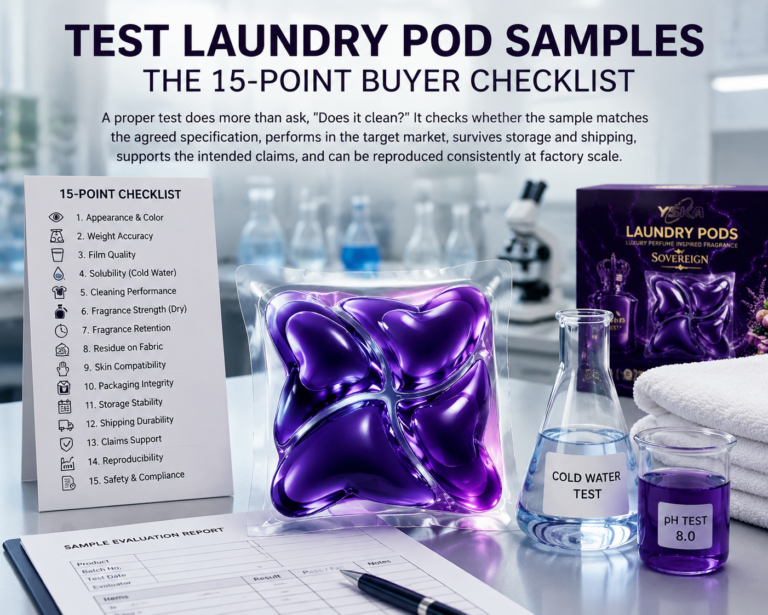
Before bulk production, use SHINEC’s 15-point laundry pod sample testing checklist to compare the approved formula, film, seal, cleaning, fragrance and packaging under recorded conditions.
A supplier may understand a fragrance reference, but a premium brand should commission an original composition rather than market an exact copy. Describe the mood, fragrance family, note structure and dry-fabric performance you want. Separately review product naming, packaging and advertising for the target market.
Signature fragrance laundry pods expresses the idea of an original, brand-owned scent direction. “Perfume-inspired laundry pods” is useful for the broader category, while “custom fragrance laundry pods” can describe the OEM service. Use each term on a page with a clearly different search intent to avoid internal keyword competition.
Two or three well-defined scent territories are usually more useful than a large unstructured selection. Each sample should carry a code and version date. Compare them under the same wash and drying conditions, then provide consolidated feedback linked to the written brief.
No. A fragrance supplier’s Certificate of Conformity addresses a specified fragrance mixture and intended use under the IFRA Standards. It does not replace the finished product’s safety assessment, classification, labeling, packaging or other national and local requirements.
Define the wash program, water conditions, pod dose, load, reference fabrics, drying method, evaluation times, sensory method and acceptance criteria. Keep records that connect the claim to the exact formula and sample. Do not apply one result automatically to every scent or pod format.
Approve the fragrance code, detergent formula, dosage, pod weight, chamber format, color, film, packaging, artwork, product specification, required documents, test results and golden sample. Confirm which changes require written buyer approval.
Signature fragrance laundry pods become valuable when creativity and production discipline support each other. The scent should be original enough to build brand recognition, technically compatible with the detergent and film, supported by appropriate documentation, approved on washed fabric and controlled against a signed production standard.
The seven-step route is practical: define the consumer, create an original territory, design the fragrance pyramid for fabric, adapt it to the complete pod formula, run coded wash tests, review names and documents, and lock a golden sample. That process creates a stronger long-term asset than copying the name, packaging or identity of a luxury perfume.
To begin a private label project, contact SHINEC with your target market, fragrance direction, pod weight, chamber format, packaging idea and intended claims. The team can then discuss sample directions, testing needs and a project-specific OEM/ODM quotation.