Leave A Message
Tips: Kindly notice that reply of inquiry via email may went into spam, please kindly check your spam if you have sent inquiry email and do not receive replies, thank you.

Private label laundry scent boosters give a laundry brand a new way to create a premium fragrance moment in every wash without redesigning its whole detergent line. A successful launch is not simply choosing a pleasant scent and adding a logo to a bottle. It begins with a clear customer and market brief, then connects fragrance direction, concentrated formula, bottle and packaging choices, sample testing, compliance planning and a project-specific order plan.
For brand owners, importers and retailers, the objective is to create a product that feels distinctive, repeatable and commercially practical. This guide explains how to launch a private label laundry scent booster from first brief to approved bulk-production standard, with the questions that should be answered before you request a quotation.
Start by defining what the product is intended to do in the routine. A laundry scent booster is generally designed to add a concentrated fragrance experience during the wash. It is not the same as a detergent, and it should not be positioned as a substitute for fabric softener unless the selected formula and local labeling support that role.
That distinction affects the consumer promise, recommended use, formula direction, bottle instructions and comparison set. Before development begins, write a one-page brief that answers: Who is the target customer? Is the desired impression fresh, floral, fruity, woody or amber-led? Is the product intended for an everyday value line, a premium collection or a giftable fragrance-led launch? Which markets and sales channels are planned first?
A specific brief prevents a common problem: a product that looks premium but has no clear reason for a shopper to choose it. The strongest private label laundry scent booster projects translate a recognizable brand mood into a usable laundry experience. A launch-ready private label laundry scent booster should make that mood clear through its formula, fragrance, bottle and usage story.
Planning a fragrance-led laundry line? Explore SHINEC’s premium laundry scent booster options and share your intended market, bottle size and fragrance direction through our project enquiry form.
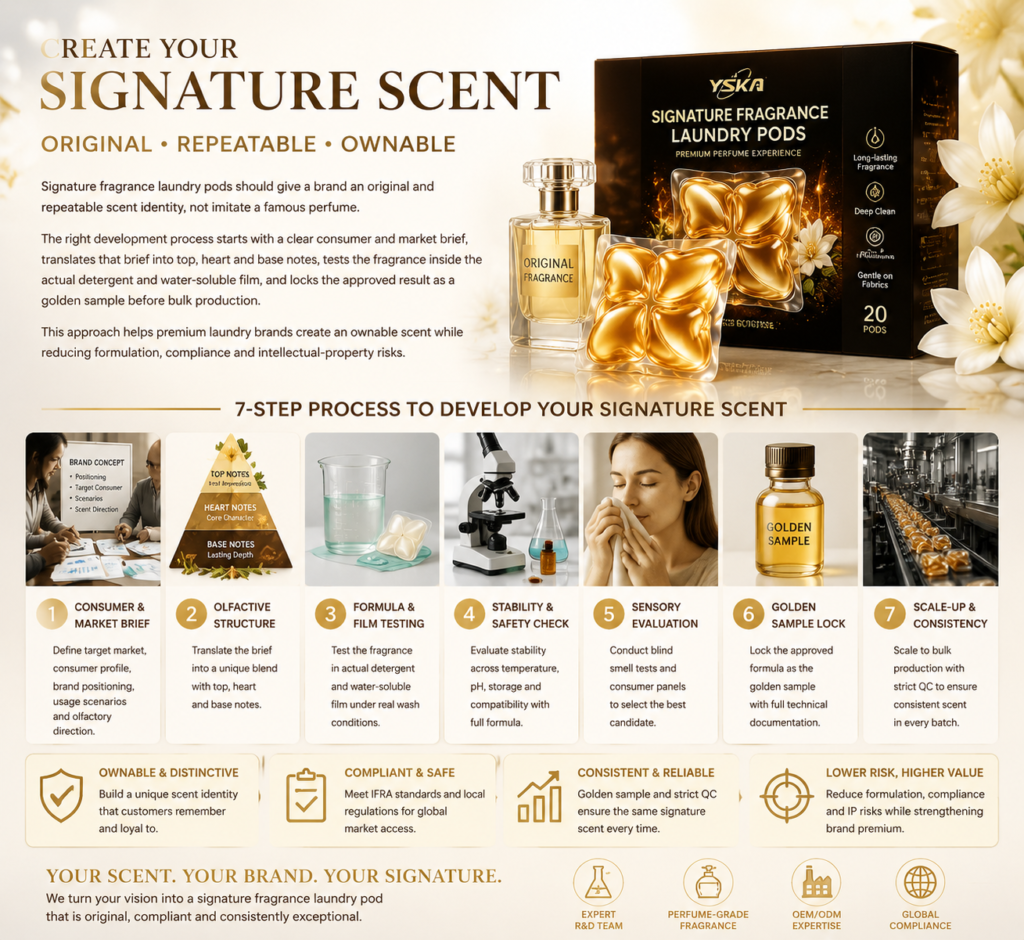
Luxury positioning does not require copying a famous perfume. It requires an ownable scent direction that can be described clearly, tested inside the real formula and reproduced from batch to batch. A useful fragrance brief normally includes the desired overall family, the first impression, the heart of the scent and the dry-down or lingering character.
Ask for fragrance evaluation in the actual scent-booster base rather than judging a fragrance oil alone. Heat, water, storage time, raw materials and packaging can all affect perceived performance. For international projects, fragrance documentation and safe-use expectations should be reviewed with the selected fragrance supplier; the IFRA Standards framework is a useful reference point for fragrance safety assessment, but it does not replace market-specific product compliance work.
A private label laundry scent booster should be evaluated as a complete use experience, not only an initial fragrance intensity. A concentrated laundry scent booster can be developed around fragrance beads, pearls or other project-selected delivery formats, but the preferred direction must be assessed for flow, dosing, storage stability, fragrance compatibility and consumer handling.
During development, confirm the recommended dose range, the number of washes the final pack is designed to support, and whether the product is intended to be added directly to the drum or used through another method. These instructions must be realistic for the formula, pack size and target market. Avoid promising a fixed number of loads before the final dose and formula have been approved.
If your range also includes detergent capsules, coordinate the fragrance story across both categories. A shopper should be able to understand whether the scent booster is a stand-alone fragrance upgrade, a companion to your detergent, or part of a complete laundry ritual. See our luxury fragrance laundry pod collection for a complementary format direction.
Packaging is part of the product experience and part of risk control. Choose the bottle shape, capacity, material, cap type, label area and outer-pack requirement with the intended channel in mind. A premium bottle should be easy to hold, visually consistent with the brand and suitable for the selected formula and transportation route.
Bring the packaging conversation forward instead of leaving it until the sample is approved. The cap, liner, neck finish, label adhesive and carton arrangement can affect filling, leakage resistance, shelf display and freight efficiency. If a custom mold or special decoration is required, the project timeline and commercial decision need to account for it early.
For a first launch, many buyers start with an existing bottle platform plus custom label, color direction and outer carton. That approach can reduce development variables while keeping the final product clearly brand-owned. More extensive customization can be evaluated after the formula and market response are proven.
Premium copy should make a product easier to understand, not create regulatory risk. Keep the front label focused on supported product attributes such as the fragrance profile, recommended use and pack information. Claims about cleaning, softening, antimicrobial activity, hypoallergenic properties, sustainability or safety should only be used when they are supported by the final formula, evidence and target-market rules.
Make room for the practical label content from the start: ingredient and hazard information where applicable, directions, warnings, responsible-party details, barcode, batch coding and language requirements. Requirements differ by country, so a U.S. launch and an EU launch should not be treated as a single labeling exercise.
A sample is a decision tool, not just a sales sample. Test it under conditions close to the way the end customer will use it. Check appearance, fragrance impression, dose control, flow, residue, bottle handling, leakage resistance and compatibility with the intended laundry routine. Compare samples against the written brief, not only against the first pleasant smell.
Record the approved formula, fragrance direction, pack materials, artwork version and acceptance criteria in a golden-sample file. This creates a shared bulk-production reference and reduces the chance that a later batch is approved against memory rather than an agreed standard. For a broader buyer checklist, read How to Test Laundry Pod Samples Before Bulk Production.
Before you approve a sample: send the target country, planned retail channel, bottle preference and fragrance family. SHINEC can then align the sampling discussion with your private-label objective rather than offering a generic option.
Compliance is not one certificate that makes a product legal everywhere. The required documents and labeling depend on the final formulation, fragrance, packaging, intended claims, importing party and destination market. Ask early which documents can be supplied for the selected product and which obligations remain with the importer, brand owner or local responsible party.
For EU-facing projects, product classification, labeling and packaging obligations may require review under applicable rules, including REACH and CLP considerations where relevant. For U.S. projects, the correct path depends on the product category and claims. Do not use a CE or test document as a shortcut for a complete market-access assessment. A document must always be read with its stated product, sample, test method and scope.
Buyers considering laundry pods as well as scent boosters can compare the documentation workflow in our U.S. and EU laundry pod compliance guide.
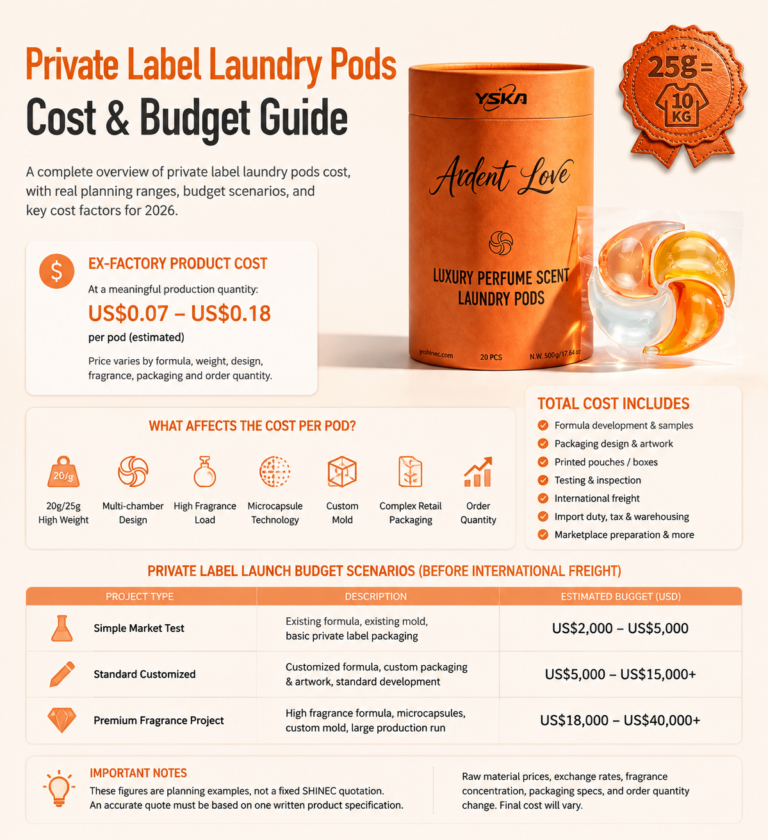
There is no responsible universal MOQ or price for a private label laundry scent booster. The commercial plan depends on factors such as formula complexity, fragrance selection, bottle and cap, decoration, label, outer carton, destination market, documentation needs and order quantity. Requesting a quote without these details usually produces a number that is too broad to make a real decision.
Prepare a concise quotation request with your target market, product position, fragrance direction, expected pack size, preferred packaging level, estimated order volume and required launch timing. Then confirm what is included in the quotation, which customization items have separate costs, what sampling is needed, and what must be finalized before bulk production can begin.
Once the commercial details are agreed, lock the golden sample and final artwork before scale-up. A disciplined approval stage gives your brand a clearer path from concept to repeatable production.
A private label laundry scent booster needs a simple usage story for each sales channel. Marketplace shoppers look for a clear pack size, dosage and scent description. Retail buyers need shelf logic, case configuration and practical labeling. Distributors need documents, lead times and a dependable replenishment plan. The product should answer the same basic question everywhere: what fragrance experience does the customer get, how is it used and why does it belong in the laundry routine?
For a premium launch, keep the message specific rather than exaggerated. Explain the fragrance family, the recommended dose and the intended wash experience. A private label laundry scent booster can be positioned around floral, fruity, woody, fresh or amber directions, but the final wording must match the approved formula and local labeling rules. Clear language builds trust and prevents a luxury-looking bottle from feeling vague after purchase.
Before printing the label, test whether consumers can follow the instructions without help. State where the product goes, how much to use, how many loads a bottle supports and any storage guidance. If the product is concentrated, an easy measuring cue can reduce overdosing and support repeat purchase. A private label laundry scent booster works best when the package makes the first use feel uncomplicated.
The cost of a private label laundry scent booster is not only the formula cost. It includes fragrance level, bottle resin, cap, label or shrink sleeve, outer carton, filling efficiency, inspection, testing, storage and destination requirements. A premium fragrance concept can still be commercially sensible, but the target retail price, distributor margin and order volume should be discussed before artwork is finalized.
Ask for at least two practical scenarios: an entry launch with a straightforward bottle and label, and a more premium option with upgraded packaging or a more developed fragrance profile. Comparing the scenarios helps a buyer see where the value is coming from. For a private label laundry scent booster, the best option is usually the one that protects product experience without creating a pack cost that the planned channel cannot absorb.
A useful cost sheet separates fixed setup costs from variable unit costs. It should show the selected bottle size, fill weight or volume, fragrance direction, packaging components, artwork status, estimated order quantity and the commercial assumptions behind the quotation. This makes it easier to compare a private label laundry scent booster project fairly and prevents a low initial price from hiding later changes in packaging or documentation.
Fragrance-led laundry products are sensitive to practical details. A private label laundry scent booster should be assessed after storage at normal and elevated conditions, as appropriate for the project. Check color, odor, separation, leakage, cap fit, label adhesion and overall appearance. The aim is not to promise that every formula behaves identically; it is to confirm that the approved sample performs as intended in the chosen bottle and pack configuration.
Shipping conditions matter too. A bottle that looks fine in a laboratory can still need improvements for carton stacking, cap torque or label material. Record the checks in the technical file and keep the approved sample as the reference point. This is particularly important when a private label laundry scent booster will move through warm ports, long warehouse stays or mixed distribution channels.
The golden sample should represent the complete consumer-facing product: formula, fragrance, bottle, cap, label and outer packaging where relevant. When any element changes, review whether another confirmation sample is needed. A private label laundry scent booster is easier to scale when the factory and buyer are working from the same physical and documented reference.
Before bulk production, assemble a short validation pack for the buyer. It can include the approved sample, fragrance brief, product specification, usage instructions, packaging artwork approval, quotation, production timeline and any project-relevant test or safety documents. This gives commercial, sourcing and quality teams one aligned record instead of separate versions of the same decision.
A private label laundry scent booster project moves more smoothly when the buyer confirms the open points in writing: final fragrance, bottle size, label text, target market, carton configuration and acceptance criteria. It is a modest amount of discipline that can save weeks of avoidable back-and-forth later.
Mass production should begin only after the formula, pack, artwork and commercial plan are aligned. A private label laundry scent booster is not ready simply because the bottle looks good in a presentation. It is ready when the buyer has approved the sample, the correct packaging file is locked, the required documentation is identified and the production plan reflects the agreed order quantity.
Use one approval checklist with named owners and dates. It should include formula sign-off, fragrance sign-off, artwork sign-off, packaging material confirmation, inspection standards, shipping marks and balance-payment milestones where applicable. This simple approval gate gives a private label laundry scent booster a more controlled route from concept to repeatable supply.
A private label laundry scent booster is a fragrance-focused laundry product developed for a brand to sell under its own name. The buyer can typically discuss fragrance direction, formula requirements, bottle format, labeling and packaging, subject to technical feasibility and the target market.
Yes. A custom fragrance brief can guide sampling, for example floral, fruity, fresh, woody or amber-led. The final fragrance should be evaluated in the actual formula and then approved against a physical sample before bulk production.
MOQ depends on the formula, fragrance, bottle, cap, label, outer packaging and whether materials are standard or custom. The most accurate approach is to request a project-specific MOQ after you have confirmed the market, bottle size and packaging direction.
The timing depends on sample rounds, artwork approvals, packaging procurement and production scheduling. A clear brief and quick confirmation of samples and packaging files usually help reduce avoidable delays.
Share your target market, preferred fragrance family, bottle size, estimated quantity, packaging preference, sales channel and desired launch date. That information lets the supplier prepare a more realistic private label laundry scent booster proposal.
Yes. Test the sample in the intended use context and review fragrance, appearance, dosage, pack handling and label instructions. For a private label laundry scent booster, the approved sample should become the product reference before mass production is released.
The best private-label scent booster launches begin with a specific customer and fragrance story, then protect that idea through realistic formula, packaging, testing and documentation decisions. The goal is a product that looks premium on shelf, feels consistent in use and can be reproduced with confidence as the brand grows.
Ready to discuss a custom private label laundry scent booster? Send SHINEC your project brief with your target market, scent direction and preferred packaging concept.