Leave A Message
Tips: Kindly notice that reply of inquiry via email may went into spam, please kindly check your spam if you have sent inquiry email and do not receive replies, thank you.

Choosing between 20g vs 25g laundry pods is not simply a matter of selecting the larger pod. A 20g format is often suitable for mainstream household loads, compact packaging and competitive cost per wash, while a 25g format can support larger-load positioning and a more substantial premium presentation. The right choice depends on formula concentration, target load, fragrance system, package count, retail price and verified wash performance.

The stated weight is the total filled weight of one finished pod. It does not automatically reveal the amount of surfactant, enzyme, builder, fragrance or other functional material inside the formula. Two 20g products can perform differently, and a well-designed 20g formula may outperform a weak 25g formula under the same wash conditions.
For a useful 20g vs 25g laundry pods comparison, buyers should request the complete product specification rather than judging the front-of-pack number alone. At minimum, compare formula version, chamber structure, target load, fragrance system, water-soluble film, fill-weight tolerance, cleaning test and recommended dosage.
Pod weight also affects several commercial decisions at once:
Weight should therefore be treated as one design variable inside a complete product system, not as a stand-alone quality grade.
| Decision factor | 20g format | 25g format | What the buyer must verify |
|---|---|---|---|
| Typical positioning | Mainstream or premium everyday wash | Larger-load or substantial premium format | Target consumer and actual machine habits |
| SHINEC catalog reference | Approximately 7kg for the relevant rich-fragrance formats | Approximately 8-10kg for the relevant rich-fragrance formats | Final formula and controlled wash test |
| Package count | More units may fit at a given net product weight | Fewer units at the same net product weight | Pouch, box or tub dimensions |
| Cost per pod | Usually lower, all else equal | Usually higher, all else equal | Formula, film, fragrance, chambers and packaging |
| Freight exposure | Lower product weight per equal pod count | Higher product weight per equal pod count | Carton configuration and Incoterm |
| Visual impact | Compact and familiar | Larger, more substantial presentation | Shape, chamber layout and e-commerce image |
| Fragrance opportunity | Can support premium fragrance when compatible | More room does not automatically mean better scent | Dosage, microcapsules, stability and sensory test |
| Best use case | Standard household loads and price-sensitive launch | Larger-load positioning or premium value story | Market research and sample data |
This table is a starting point. It is not a universal dosage instruction. The label recommendation should be based on the exact formula, test method, washer conditions, load and local requirements.
A buyer should first define the load that consumers actually wash. Household size, washer capacity, textile type, water level, soil level and local washing habits all influence the required dose. The American Cleaning Institute notes that poor soil removal may result from insufficient detergent, low wash temperature or washer overloading, which is why a pod cannot be evaluated separately from the use conditions. Its laundry-use guidance also advises users to follow the washer and product instructions and place liquid laundry packets in the drum before clothing.
For a North American e-commerce product, a brand may prioritize convenience, a clear one-pod claim for a defined regular load and a strong cost-per-wash comparison. In some African, Latin American or family-oriented channels, consumers may wash heavier mixed loads and respond better to a visibly substantial format. Those are hypotheses to test, not stereotypes to print as facts.
Before choosing 20g vs 25g laundry pods, collect the following market inputs:
The best pod weight is the one that can deliver a repeatable result under those conditions while keeping the dosage instruction simple.
A 25g pod contains five more grams of finished formula than a 20g pod, but it does not follow that it delivers 25% more cleaning performance. Performance depends on what those grams contain and how the ingredients work together.
Ask the manufacturer to explain the role of the additional formula. It may increase surfactant, solvent, builder, enzyme, fragrance, softening component or simply water and carrier content. Buyers should compare the active system, not only total weight. Where the supplier uses terms such as “concentrated” or “8x,” request the exact formula, reference benchmark and test specification supporting that grade.
SHINEC’s verified product baseline allows wording such as “cleaning-performance grades up to 8x are available, depending on the selected formula and test specification.” It should not be converted into a claim that every 20g or 25g product automatically has the same cleaning power.
The formula also has to work with the water-soluble film. Higher fill weight or a changed solvent balance may affect pod shape, sealing, storage behavior and dissolution. A scale-up should therefore confirm:
The practical question is not “Which pod is bigger?” It is “Which complete formula gives the required result at the intended dose?”
A larger pod can provide more formulation space, but 25g does not automatically mean stronger or longer-lasting fragrance. Fragrance performance depends on fragrance type, dosage, detergent-base odor, volatility, fabric type, drying method, microcapsule system and formula stability.
For specific SHINEC rich-fragrance formats, the current catalog reference is 4% fragrance plus 2% microcapsules in both 20g and 25g options. The 20g format is associated with an approximately 7kg suggested load, while the 25g option is associated with approximately 8-10kg. These figures apply to the stated product family and must be reconfirmed against the final sample and commercial specification.
When developing luxury fragrance laundry pods, compare scent at four stages: package opening, wet fabric, dry fabric and stored fabric. Use identical loads, textiles, wash programs and evaluation times. A heavier pod may smell stronger in the package but still deliver a less balanced dry-fabric result.
The International Fragrance Association explains that its Standards restrict, prohibit or specify conditions for certain fragrance materials and that a supplier’s conformity certificate relates to a specified intended use. Fragrance dosage must therefore be reviewed for the intended product application; higher is not automatically safer, more compliant or more premium.
Premium fragrance is created by clarity, balance and repeatability. Buyers should approve an original fragrance direction, compatibility result and golden sample rather than selecting 25g only because it appears capable of holding more perfume.
The 25g option will normally use more formula and may require larger packaging or lower units per carton, so its ex-factory and freight cost per pod can be higher. Yet a higher unit cost can still make commercial sense if the product supports a larger verified load, a stronger retail story or a higher selling price.
Build a cost model with these fields:
| Cost item | Buyer calculation |
|---|---|
| Formula cost | Cost per kilogram x filled weight |
| Film and chamber cost | Film area, mold/chamber format and process complexity |
| Fragrance system | Fragrance oil, microcapsules and compatibility work |
| Primary packaging | Pouch, box or tub plus closure and barrier requirement |
| Pack-out | Pods per retail unit, units per carton and carton size |
| Development | Samples, artwork, plates, molds and project testing |
| Freight | Gross carton weight, volume, route and Incoterm |
| Market economics | Landed cost, distributor margin, retail price and cost per wash |
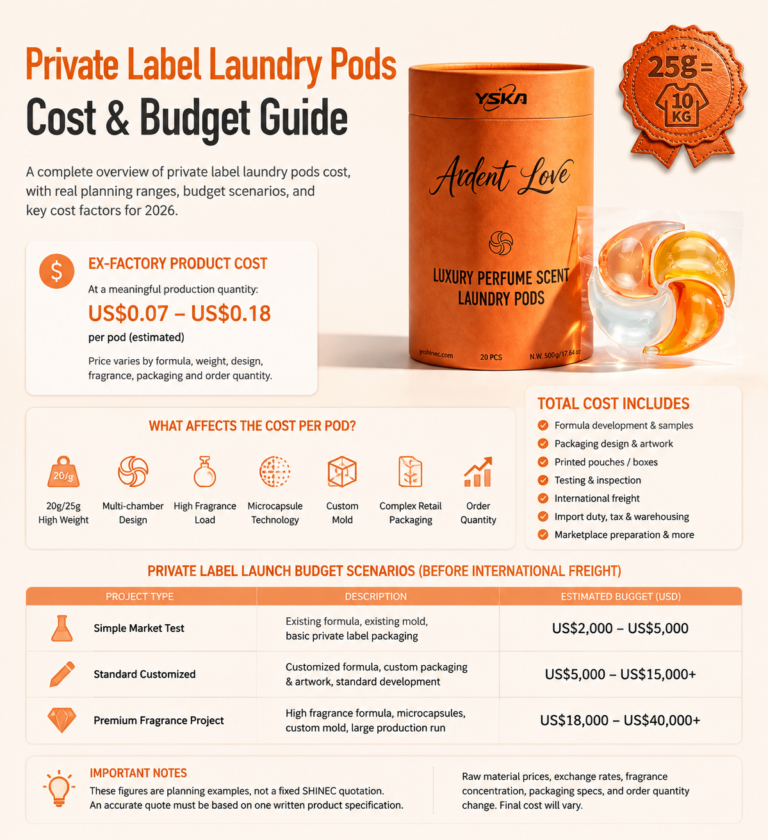
Do not compare a quotation for 20g basic formula in a stock pouch with a quotation for 25g multi-chamber premium formula in custom packaging. Standardize the RFQ before judging the supplier. SHINEC’s guide to private label laundry pod costs explains the other variables that should be included.
Weight influences the package architecture. If the brand wants 30 pods in a compact stand-up pouch, a 25g product may require a larger pouch, stronger zipper area or different carton. If the brand sells 20 pods in a premium tub, the larger format may enhance visual value even when the total pack count is lower.
Compare package options using physical mock-ups rather than screen artwork alone. Check:
For private-label launches, 20g can help preserve a familiar pack count and accessible price. A 25g format can support a larger-load proposition, but only when the front-of-pack benefit is easy to understand and the price difference is justified.
The most reliable 20g vs 25g laundry pods decision comes from a controlled sample test. Smelling the pod and running one household wash are not enough.
Use a comparison matrix that records:
Run repeated washes rather than relying on a single result. If the 25g pod is intended for a larger load, compare it at that load and also conduct a matched-load test to understand what the extra dose changes. If both formats use different formulas, clearly label the study as a complete-product comparison rather than a pure weight comparison.
SHINEC’s 15-point laundry pod sample testing checklist provides a fuller protocol. Buyers should sign a golden sample and retain the approved formula, fragrance, color, weight, film, packaging and test record before bulk production.
Watch this SHINEC short as a visual reference alongside the specification and sample checks in this guide.
Watch the laundry pod video on YouTube
A 20g option may fit when the target load is moderate, shelf price is sensitive, pack count matters and the formula already meets the required cleaning and fragrance standard. It can also work for premium fragrance positioning when compatibility and dry-fabric testing support the concept.
A 25g option may fit larger household loads, higher-dose formulas or a premium presentation. The value proposition should be tested and stated clearly. Avoid implying that the consumer can overload the washer simply because the pod is heavier.
Some brands can use 20g as the core SKU and 25g as a family-load or premium-strength option. This creates a useful price ladder only when package design, dosage language and product naming prevent confusion. Two nearly identical SKUs can dilute inventory and marketing resources.
Search behavior, retail conventions and washing habits vary within every country. Use distributor interviews, sample panels, competitor pack audits and early sales data. A market label such as “North America” or “Africa” is not sufficient evidence for a dosage decision.
Send the same written brief to every potential manufacturer:
The manufacturer should state which elements are standard, which require customization and which remain subject to testing. Current MOQ, price, development time and stock packaging must be confirmed for the exact project. Do not treat a catalog reference as a binding quotation.
You can also review the laundry pods OEM process to see where weight selection, samples, packaging and quality approval fit before mass production.
Not automatically. A 25g pod contains more finished formula, but cleaning strength depends on concentration and ingredient system. Compare the formula specification and controlled wash results.
For the relevant SHINEC rich-fragrance formats, the catalog reference is approximately 7kg. This is not a universal rule for every 20g pod. Confirm the exact formula, washer conditions, soil level and label instruction.
The relevant SHINEC rich-fragrance catalog reference is approximately 8-10kg. The final recommendation must be supported by the selected formula and project test conditions.
Not by weight alone. Fragrance quality, dosage, microcapsules, detergent compatibility, fabric and drying conditions have more influence than the total pod weight by itself.
The 20g format will often have a lower formula and freight cost per pod when all other specifications are equal. Final cost also depends on chambers, film, fragrance, packaging, order volume, testing and shipping terms.
Yes, when each has a clear role, such as regular-load and larger-load positioning. Test demand and keep the labels, dosage instructions and packaging visually distinct.
The right answer in a 20g vs 25g laundry pods project is the format that meets the target load, cleaning, fragrance, packaging and cost requirements under repeatable conditions. A 20g pod can be the stronger commercial choice for an efficient everyday SKU. A 25g pod can be the better choice for a tested larger-load or premium proposition. Neither weight is a quality guarantee by itself.
SHINEC provides laundry pods OEM/ODM services covering formula, fragrance, color, chamber design and packaging coordination. The current product baseline includes 20g and 25g rich-fragrance options; final specifications, MOQ, documentation, test scope, price and lead time are confirmed per project.