Leave A Message
Tips: Kindly notice that reply of inquiry via email may went into spam, please kindly check your spam if you have sent inquiry email and do not receive replies, thank you.

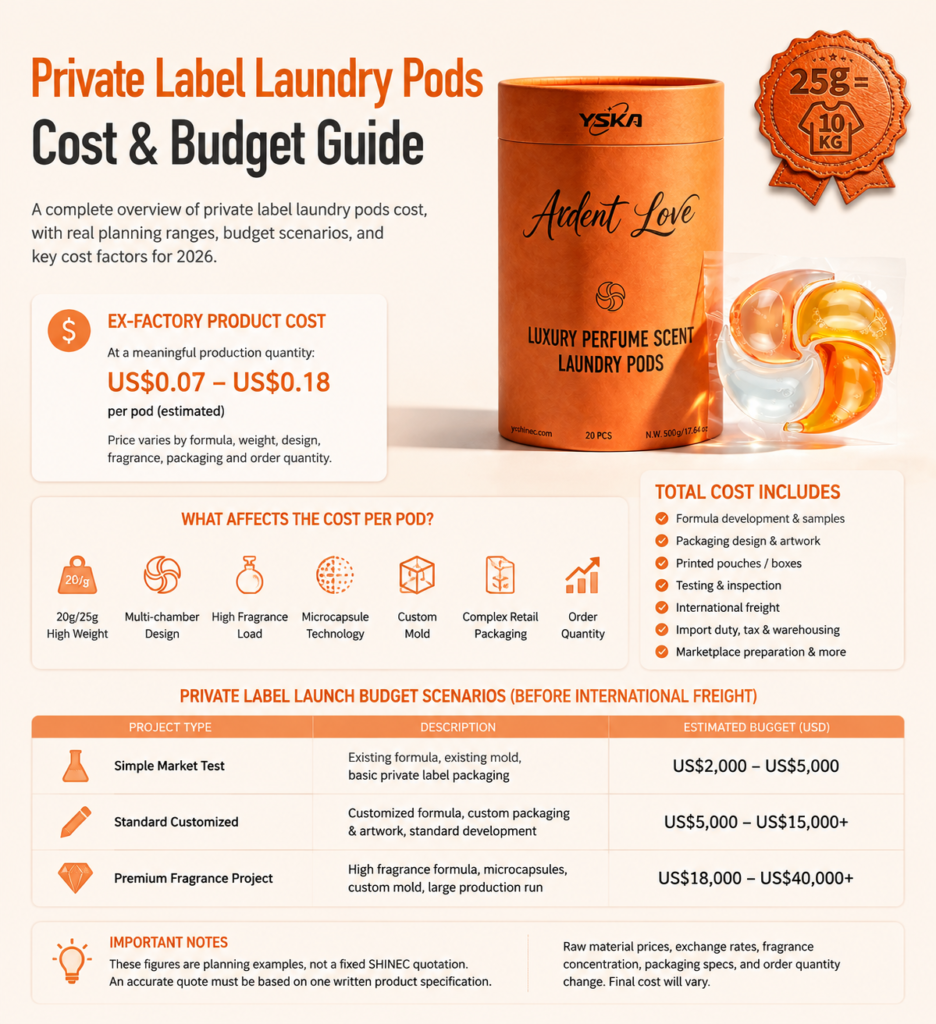
Private label laundry pods cost is rarely one fixed number. As a practical planning range, a standard private label project may use an estimated ex-factory product cost of about US$0.07 to US$0.18 per pod at a meaningful production quantity. Small pilot runs, premium 20g or 25g pods, multi-chamber designs, high fragrance loads, microcapsules, custom molds, and complex retail packaging can move the price above that range.
The total launch budget is also much larger than the pod price alone. A buyer may need to pay for formula development, samples, packaging artwork, printed pouches or boxes, testing, inspection, freight, import duty, tax, warehousing, and marketplace preparation. For that reason, two suppliers can quote the same price per pod while offering very different total value.
For a simple market test using an existing formula, existing mold, and basic private label packaging, a buyer may plan roughly US$2,000 to US$5,000 before international freight. A standard customized project can require US$5,000 to US$15,000 or more. A premium fragrance project with a large custom production run may require US$18,000 to US$40,000 or more before freight and local import charges.
These figures are planning examples, not a fixed SHINEC quotation. Raw material prices, exchange rates, fragrance concentration, packaging specifications, and order quantity change. An accurate quote must be based on one written product specification.
This guide explains every major private label laundry pods cost, shows realistic budget scenarios, and gives buyers a clear method for comparing OEM quotations.
The first mistake buyers make is asking only, “What is your price per pod?” A useful question is: “What is my total cost to receive a sale-ready product in my warehouse?” The first number is an ex-factory unit price. The second is the landed cost that determines your real margin.
The ex-factory product cost normally covers the detergent formula, water-soluble film, fragrance, color, production labor, normal quality control, and the agreed primary packaging. However, every quotation is different. One quote may include a printed pouch, while another may cover loose pods in a bulk carton only.
Before comparing OEM laundry pods pricing, ask each manufacturer to state exactly what the unit includes:
Without this information, a low quote can be a false bargain.
Some costs occur only at the start of a project. These can include fragrance matching, formula development, color trials, mold development, artwork adaptation, printing plates, barcode setup, sample shipping, and market-specific testing.
An existing formula with an existing pod shape usually has the lowest development cost. A new four-chamber shape, exclusive fragrance, special cleaning claim, and custom jar can create several separate development charges. Buyers should ask which charges are refundable, which are credited after a bulk order, and which belong to the supplier.
Landed cost is the amount paid to place usable inventory in your warehouse. A simple formula is:
Landed cost per retail pack = product and packaging cost + development allocation + testing allocation + inspection + freight + insurance + duty + tax + customs and local delivery, divided by saleable packs received.
This calculation should use saleable units, not units ordered. Allow for samples, inspection pieces, normal transport damage, and any retailer reserve stock.
Assume a buyer orders 50,000 pods packed as 25 pods per pouch. That creates 2,000 retail pouches.
| Cost Item | Illustrative Amount |
|---|---|
| 50,000 finished pods at US$0.11 each | US$5,500 |
| Packaging setup and artwork adaptation | US$500 |
| Additional testing and document preparation | US$800 |
| Third-party pre-shipment inspection | US$350 |
| Freight, insurance, customs, and local delivery | US$2,200 |
| Estimated total landed project cost | US$9,350 |
| Estimated landed cost per 25-pod pouch | US$4.68 |
This example does not represent a live quote. Its purpose is to show why a US$2.75 ex-factory pouch can become a US$4.68 landed pouch. If the buyer calculates margin using only the first number, the launch plan may fail.
Private label laundry pods cost changes when any part of the product specification changes. The following 12 factors have the greatest effect.
An 8g pod uses less detergent and film than a 20g or 25g pod, so it normally costs less per piece. However, cost per wash may tell a different story. A larger pod may serve a larger wash load and support a more premium position.
SHINEC supports laundry pod formats from 8g to 25g. Its current catalog includes compact single-chamber pods, 12g and 15g formats, and high-weight 20g and 25g formats. Buyers should match pod weight to local washing habits, machine size, water hardness, soil level, and the desired retail price.
Surfactants, enzymes, builders, dispersants, fragrance, and other functional ingredients determine cleaning performance and material cost. A basic formula and a high-concentration formula should not be compared only by pod weight.
SHINEC can provide cleaning-performance grades from 2x to 8x for specified formulas and test requirements. An 8x cleaning-performance formula may cost more because it uses a different concentration and ingredient system. The buyer should request the formula specification, test method, and soil-cloth benchmark instead of relying only on a front-label claim.
A single-chamber pod is usually easier to produce. Multi-chamber pods require more complex filling control, film sealing, mold setup, and visual inspection. Heart, star, marine, windmill, sunflower, and other shapes can strengthen shelf appeal, but they may also increase MOQ and setup cost.
Using an existing mold reduces private label laundry pods cost. Developing an exclusive mold adds design, tooling, trial, adjustment, and validation work. For a first launch, an existing premium shape with custom color and packaging often gives a better risk-to-cost balance.
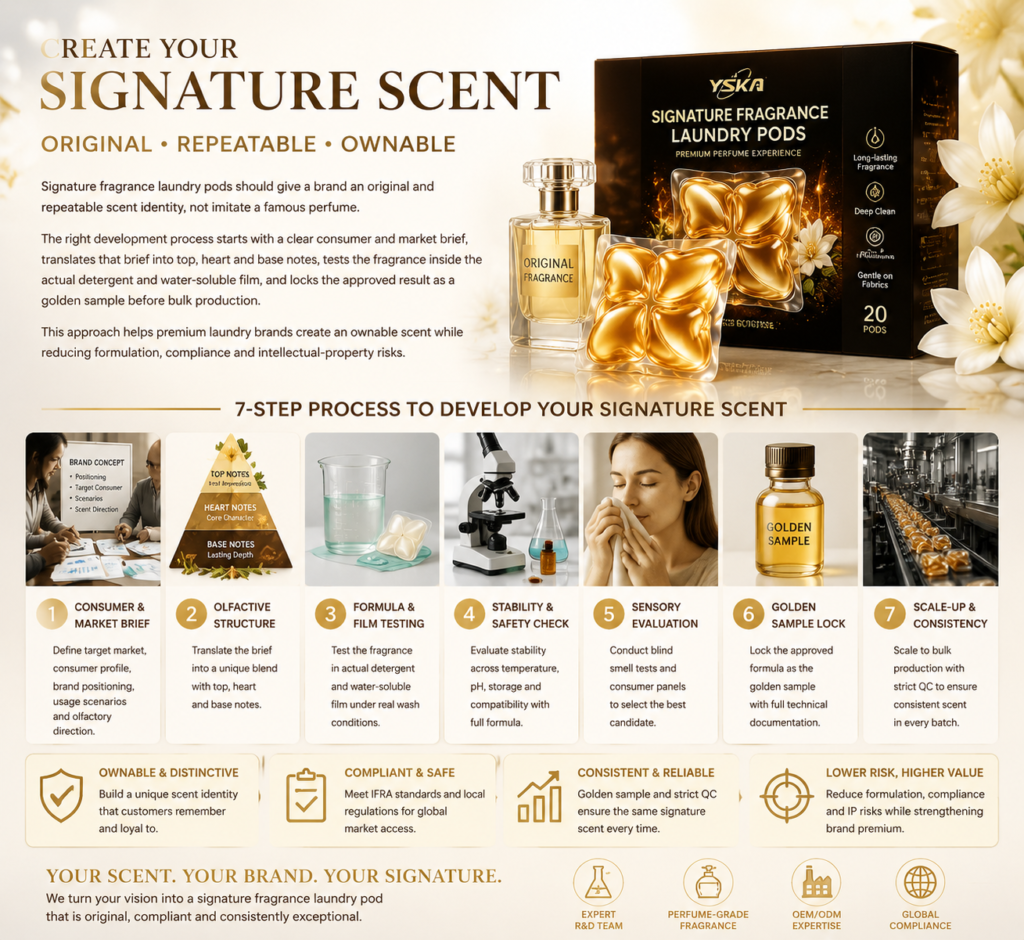
Fragrance can be a small cost in a value product or a major cost in a premium product. The price depends on the fragrance house, raw materials, concentration, stability, allergen profile, exclusivity, and matching work.
SHINEC’s premium catalog includes formulas with 4% fragrance and 2% fragrance microcapsules for selected 20g products. The Beloved, Venus Glow, Sovereign, and Polar Zone profiles use layered top, heart, and base notes. Buyers developing a premium scent can also review this guide to perfume-inspired laundry pods and the related guide to luxury fragrance laundry pods.
An existing fragrance from the manufacturer’s library is usually less expensive than a new exclusive scent. Fragrance matching also requires careful intellectual-property language. “Perfume-inspired” is safer than suggesting an official relationship with a named luxury brand.
The film must survive production, packing, transport, and storage, then dissolve correctly in use. Film thickness, source, climate resistance, sealing settings, and compatibility with the liquid formula affect both cost and product reliability.
A cheaper film can create leaking, sticking, early rupture, or slow dissolution. Those failures are far more expensive than a small material saving. Stability trials should include dry and humid conditions that reflect the destination market, especially for tropical regions.
Packaging can change private label laundry pods cost more than buyers expect. Common options include stand-up pouches, paper boxes, plastic jars, and bulk cartons. Cost depends on material, size, barrier performance, closure, printing colors, finish, label type, child-resistant features, carton strength, and order quantity.
A stock pouch with a label can support a lower-risk trial. A fully printed pouch or custom jar creates a stronger retail presentation but normally has a higher printing MOQ. For markets where children may access liquid laundry packets, packaging safety also matters. The U.S. Consumer Product Safety Commission lists ASTM F3159 as the voluntary safety standard for liquid laundry packets. Buyers should confirm current retailer and market requirements before approving a package.
MOQ spreads setup, cleaning, material preparation, printing, and quality-control costs across the production run. A small order usually has a higher unit cost because the same setup work is divided by fewer pods.
Stock formulas, existing molds, and simple packaging may support smaller trial quantities. Fully customized heart-shaped or multi-chamber projects can require much larger quantities. SHINEC’s current catalog lists 150,000 pieces for several custom-shaped models, while stocked structures may be handled differently. Every project still requires confirmation. For a deeper explanation, read the guide to laundry pods OEM MOQ.
Samples are not just miniature orders. A sample project can involve briefing, lab batching, fragrance adjustment, color adjustment, filling trials, packaging mockups, documentation, and international courier fees.
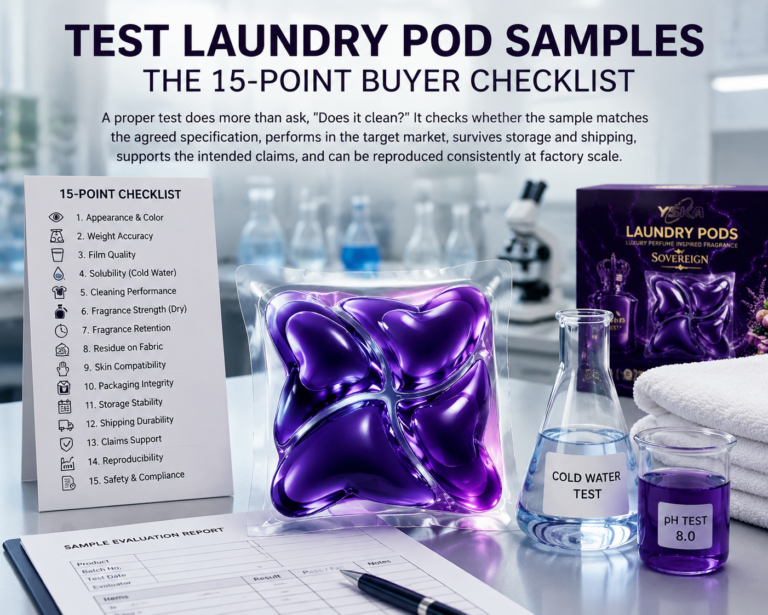
The cheapest sample is not always the best sample. Buyers should use a written scorecard and approve a golden sample before bulk production. This 15-point laundry pod sample checklist explains what to test before committing to a full order.
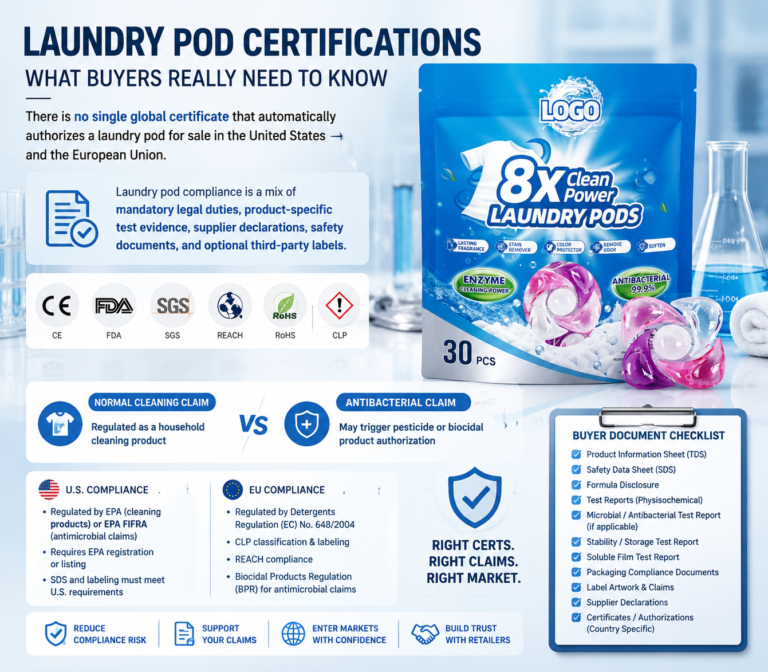
Testing cost depends on the destination market, formula, claims, packaging, and retailer. Common documents can include an SDS, COA, ingredient information, stability or performance data, transport documents, and market-specific label files. A report for one formula does not automatically cover a different fragrance, concentration, color, or claim.
For the United States, an optional environmental label such as EPA Safer Choice requires a separate review against the EPA Safer Choice Standard. It is not a generic factory certificate. For the EU, hazardous mixtures within scope may require poison-centre notification and a UFI linked to the specific composition. ECHA explains that one UFI corresponds to one mixture composition.
SHINEC maintains current COA, MSDS, REACH screening, transport documentation, and CE/Verification of Conformity documentation for specified laundry pod samples. Buyers should compare their target-market needs with the practical US and EU laundry pod certification guide.
Quality control is part of manufacturing cost, even when it is not shown as a separate line. A sound plan covers incoming materials, pre-production sample approval, in-process checks, finished-product inspection, and batch records.
Useful checks include pod weight, appearance, seal quality, leakage, pressure resistance, film behavior, pH, fragrance consistency, packaging count, carton marks, and stability. A buyer may also hire a third-party inspector before final payment. The inspection fee adds cost, but it can prevent a much larger loss.
Laundry pods are dense products. Freight changes with total gross weight, carton dimensions, pallet use, route, season, fuel surcharge, and transport mode. Air freight may work for samples, but sea freight is usually more practical for commercial volumes.
EXW, FOB, CIF, and DDP prices are not interchangeable. An EXW price can look low because the buyer still pays pickup, export handling, freight, insurance, import clearance, duty, tax, and delivery. Ask every supplier to quote the same Incoterm and destination before comparing private label laundry pods cost.
Import duty and tax depend on product classification, origin, destination, and local rules. A customs broker should confirm the correct tariff treatment. After arrival, the buyer may also pay receiving, pallet handling, storage, fulfillment, marketplace labeling, and returns costs.
Inventory risk is easy to ignore. A lower unit price does not save money if the brand orders too much, changes the artwork, or discovers that customers prefer another scent. The right MOQ is the quantity the business can sell and replenish safely, not simply the quantity that produces the lowest factory price.
The following scenarios show how product choices affect private label laundry pods cost. They are budgeting tools, not live quotations.
This project uses an existing formula, existing mold, standard color, selected stock fragrance, and basic private label packaging. It avoids exclusive tooling and major formula development.
| Item | Planning Assumption |
|---|---|
| Quantity | 10,000-20,000 pods, subject to stock and production schedule |
| Pod format | Existing 8g-20g format |
| Formula | Existing tested formula |
| Fragrance | Existing fragrance library |
| Packaging | Stock pouch or simple label solution |
| Product and setup budget | About US$2,000-US$5,000 before international freight |
This option is best for testing fragrance preference, sales channel, price point, and repeat-purchase behavior. The unit price may be higher, but the total inventory risk is lower.
This project uses an existing pod mold and proven base formula but adds a selected fragrance, custom colors, printed retail packaging, and market-specific artwork.
| Item | Planning Assumption |
|---|---|
| Quantity | 50,000-100,000 pods, depending on packaging MOQ |
| Pod format | Existing 15g or 20g format |
| Formula | Selected cleaning grade with limited adjustment |
| Fragrance | Existing profile with concentration confirmed |
| Packaging | Printed pouch or box |
| Product, development, and packaging budget | About US$5,000-US$15,000 before freight and import charges |
This is often the most balanced route for a growing brand. It creates a distinct product without paying for every possible customization.
This project focuses on a luxury-fragrance experience. It may use a 20g or 25g multi-chamber pod, higher fragrance loading, microcapsules, custom color combinations, premium print finishes, and a larger production run.
| Item | Planning Assumption |
|---|---|
| Quantity | Commonly 150,000 pods or more for selected custom formats |
| Pod format | Existing premium multi-chamber mold or exclusive mold |
| Formula | High-concentration formula, with performance grade confirmed |
| Fragrance | Layered perfume-inspired scent; selected products may use 4% fragrance plus 2% microcapsules |
| Packaging | Premium pouch, paper box, or plastic jar |
| Project budget | About US$18,000-US$40,000 or more before freight and local charges |
The largest cost is not always the fragrance. Premium packaging, custom tooling, print MOQ, testing, and excess inventory can contribute just as much. A strong product brief keeps these parts under control.
A manufacturer can quote accurately only when the buyer provides accurate inputs. “Please quote laundry pods” is too broad. A clear request for quotation saves time and makes supplier comparisons fair.
Include these points in the first serious RFQ:
If some details are unknown, say so. A good OEM partner can offer two or three specification levels instead of guessing.
The quote should separate recurring and one-time costs. Ask the supplier to identify:
This breakdown makes it easier to see whether the second order will cost less after setup charges are complete.
Compare suppliers only after each one quotes the same specification. A 20g four-chamber pod with premium fragrance cannot be compared with a 10g single-chamber value pod. A printed box cannot be compared with a bulk carton. A quote with destination freight cannot be compared with EXW.
Use a one-page specification sheet with a revision number. When any item changes, request a revised quote. This process prevents the classic dispute in which the buyer expects the sample specification but the factory priced a cheaper formula.
The approved sample should define appearance, weight, fragrance, cleaning grade, film behavior, packaging, and label. For a custom fragrance, evaluate wet scent, dry-fabric scent, and scent after storage. For a multi-chamber pod, check chamber balance and seal consistency.
Keep one signed golden sample with the buyer and one with the manufacturer. Bulk inspection should compare production with that approved version. SHINEC retains samples from bulk orders for three years, supporting batch traceability and later investigation.
Do not stop at cost per pod. Calculate cost per wash, cost per retail pack, and expected gross margin after channel fees.
Gross margin percentage = (net selling price – total landed cost – channel variable cost) / net selling price x 100.
Channel variable cost may include marketplace commission, fulfillment, payment fees, coupons, returns, distributor margin, and advertising. A product with a low manufacturing cost can still lose money when these costs are ignored.
Good cost reduction removes unnecessary complexity. It does not weaken film, reduce quality control, or replace key ingredients without validation.
An existing shape avoids new tooling and reduces production risk. SHINEC’s catalog includes single-chamber and multi-chamber formats in several weights and shapes. A brand can create a distinctive look through color, chamber contrast, fragrance, and packaging without owning a new mold.
A proven formula reduces development rounds and stability risk. The buyer can customize the cleaning grade, fragrance, color, and packaging within an established platform. A fully new formula makes sense when the target market or brand claim truly requires it.
An existing fragrance profile can reduce fragrance development time and raw-material MOQ. The brand may still create a distinctive identity by adjusting intensity, microcapsule use, color, name, and packaging story.
For a luxury line, do not cut fragrance blindly. First define the target experience and test it on dry fabric. A lower-cost scent that disappears quickly may damage repeat purchase more than it saves.
A first order does not need an exclusive formula, mold, scent, jar, and carton at the same time. Select the one or two features customers will notice most. For a premium fragrance laundry brand, that may be scent and packaging. For a value channel, it may be cost per wash and cleaning performance.
Packaging suppliers often have a different MOQ from the pod factory. A buyer may order 50,000 pods but be forced to buy enough printed film for 150,000 pods. Ask who owns and stores the unused packaging and what happens if artwork changes.
Using a label or short-run digital printing for the first launch may cost more per pack but reduce obsolete packaging. Once sales are stable, conventional printing can lower unit cost.
Testing too early creates duplicate expense. If the fragrance, surfactant level, color, or claim changes after testing, the final product may need new documents. Freeze the formula and intended claims before commissioning market-specific reports.
The most economical order is often not the largest one. Calculate expected monthly sales, replenishment lead time, safety stock, and cash available for marketing. A slightly higher unit cost with faster inventory turnover can create a healthier business.
A factory’s quote is only one part of private label laundry pods cost. Process control affects defects, delays, claims, and repeat-order consistency.
SHINEC is the company-facing brand of Shenzhen Yucheng Daily Chemical Co., Ltd., while YSKA is its product series brand. The company has more than 10 years of home-cleaning manufacturing experience, over 10 production lines, two 100,000-level GMPC-standard workshops, eight technical development engineers, and a professional laboratory of more than 300 square meters.
The laboratory uses washing machines, dishwashers, and environmental and stability testing equipment. Production control includes incoming-material checks, pre-production sample confirmation, in-process inspection, finished-product inspection, and batch traceability. Samples from bulk orders are retained for three years.
For specified laundry pod samples, available documentation includes COA, MSDS, REACH screening, transport documentation, and CE/Verification of Conformity documentation. The exact report scope must always match the final formula and target market.
Brands can use SHINEC’s OEM/ODM laundry pods services for formula, fragrance, color, shape, and packaging development. To receive a project-specific cost breakdown, send the target country, pod specification, pack count, expected quantity, and required documents through the SHINEC website.
For early budgeting, buyers may use about US$0.07-US$0.18 per pod as a broad ex-factory planning range. Small orders, premium ingredients, high fragrance loading, microcapsules, multi-chamber shapes, and premium packaging can increase the price. A final price requires a written specification and quantity.
A simple market test using an existing formula, mold, fragrance, and basic packaging may require roughly US$2,000-US$5,000 before international freight. A fully customized launch normally requires more because of packaging MOQ, development, testing, and inventory.
There is no universal best MOQ. The right quantity is large enough to spread setup cost but small enough to sell within a safe inventory period. Existing products can sometimes support smaller trials. Selected custom shapes in SHINEC’s catalog list an MOQ of 150,000 pieces. The current project must be confirmed before ordering.
Yes. Cost can increase because of fragrance material, concentration, microcapsules, matching work, testing, and the fragrance supplier’s MOQ. Choosing an existing fragrance profile usually costs less than creating an exclusive scent.
Sometimes, but never assume they are. Ask whether the price includes the retail pouch, box or jar, label, printing, export carton, artwork adaptation, printing plates, and unused packaging materials. The quote should state every included item.
The amount depends on destination, formula, claims, packaging, and retailer. Start by identifying mandatory documents and optional marketing labels. Do not buy a generic “certificate package” before confirming the final formula and the party legally responsible in the destination market.
Give both factories the same specification and Incoterm. Then compare product weight, formula, cleaning grade, fragrance percentage, chamber structure, packaging, MOQ, one-time fees, documents, quality control, lead time, and landed cost. The lowest per-pod price is not necessarily the lowest total cost.
Private label laundry pods cost depends on the entire project, not just the liquid inside one pod. Weight, cleaning grade, fragrance, microcapsules, chamber design, film, packaging, MOQ, testing, inspection, freight, duty, and inventory risk all affect the final number.
Use US$0.07-US$0.18 per pod only as an early planning range. Then replace that estimate with a written quote based on one final specification. Calculate landed cost per retail pack and include channel fees before setting the selling price.
The best first order is not the cheapest or the largest. It is the order that proves product quality, customer demand, and supply reliability without putting too much cash into inventory. Once the product has real sales data, the brand can scale volume, improve packaging, and negotiate a stronger private label laundry pods cost.
For a detailed quotation, contact SHINEC with your destination country, preferred pod weight, cleaning-performance target, fragrance direction, pack count, order quantity, and required documents at ycshinec.com.