-
Tel : +8613829237316
-
Email : solara@ycshinec.com

Perfume-Inspired Laundry Pods: 7 Proven Steps to Create Custom Scents for Premium Laundry Brands

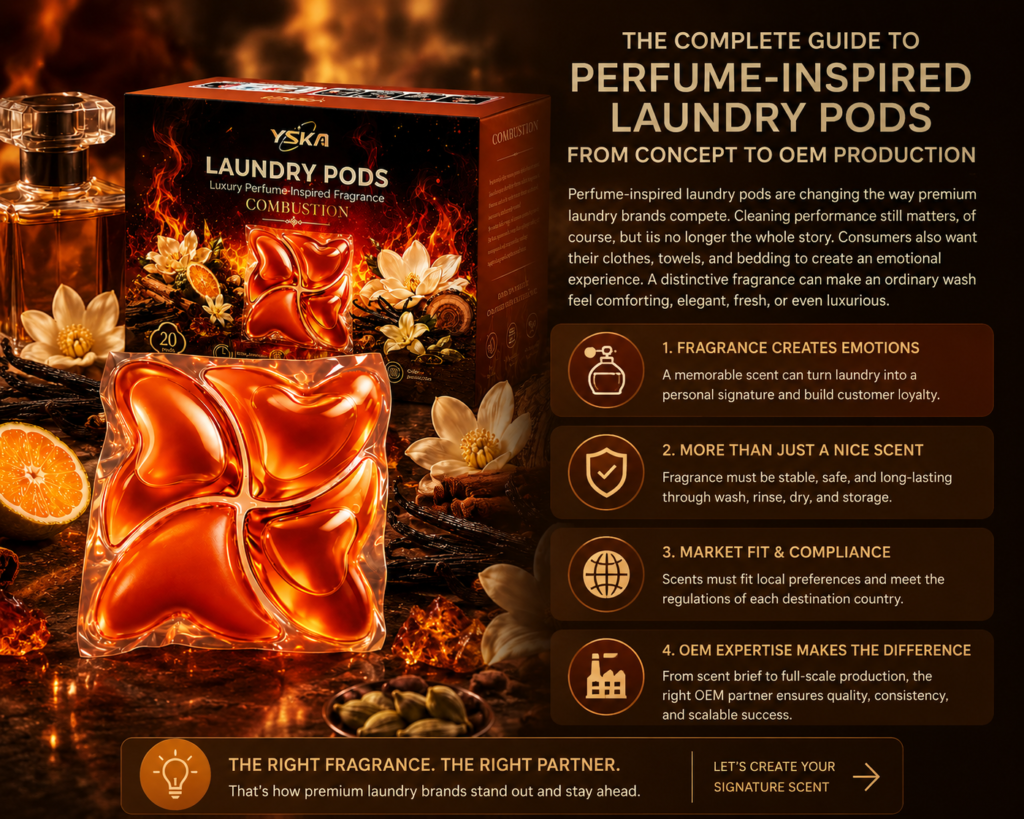
Perfume-inspired laundry pods are changing the way premium laundry brands compete. Cleaning performance still matters, of course, but it is no longer the whole story. Consumers also want their clothes, towels, and bedding to create an emotional experience. A distinctive fragrance can make an ordinary wash feel comforting, elegant, fresh, or even luxurious.
For brand owners, that emotional response is valuable. Color and packaging attract the first purchase, while a memorable scent can support repeat purchases. When customers recognize a fragrance as “the smell of my home” or “the scent of my favorite sheets,” the product has moved beyond basic cleaning. It has become part of a routine and a personal identity.
However, developing perfume-inspired laundry pods isn’t as simple as adding a fine-fragrance oil to detergent. A scent must survive surfactants, enzymes, water, heat, rinsing, drying, and storage. It also needs to fit the target market, remain consistent from batch to batch, and comply with the rules of each destination country. This guide explains how premium brands can manage that process from the first scent brief to full-scale OEM production.
1. What Are Perfume-Inspired Laundry Pods?
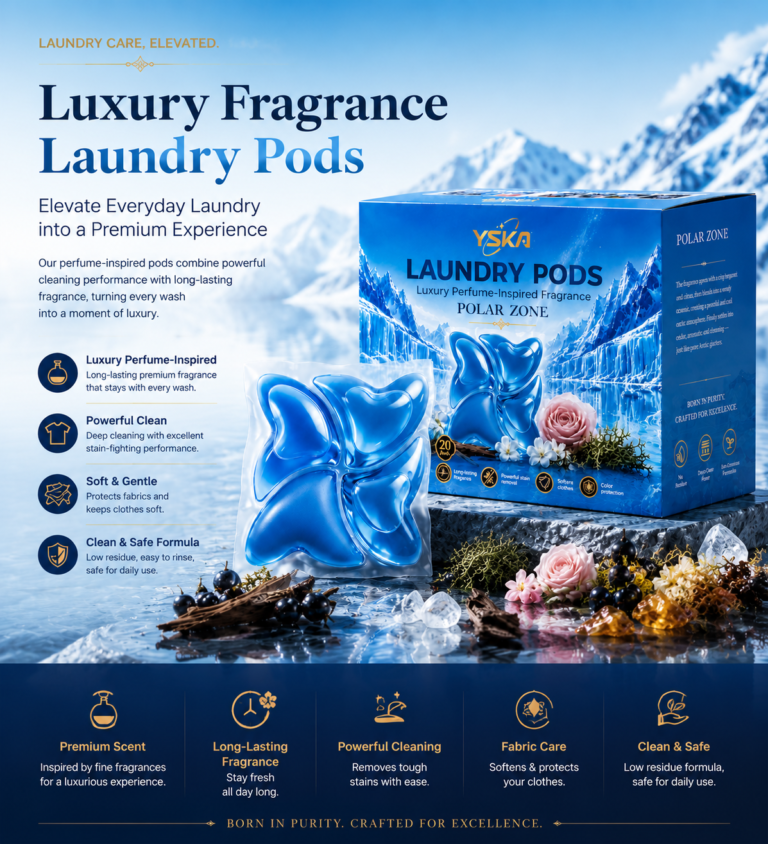
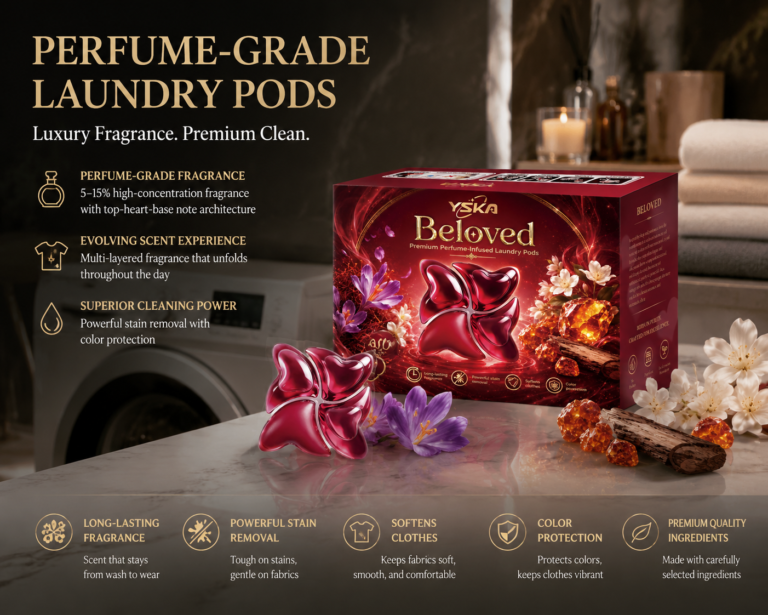
Perfume-inspired laundry pods are pre-measured detergent capsules designed around a layered, fine-fragrance-style scent experience. Instead of delivering one flat “clean” smell, they may open with bright top notes, develop into a recognizable floral, aromatic, or fruity heart, and finish with a lasting base of musk, woods, amber, or vanilla.
The word “inspired” should describe the creative approach, not an attempt to duplicate a famous perfume. Strong premium laundry brands build an original olfactive identity from fragrance families, moods, places, materials, and consumer preferences. They don’t rely on another company’s trademark, bottle design, campaign language, or confidential formula.
This distinction matters commercially. A copied scent may create short-term attention, but an ownable fragrance gives the brand a long-term asset. It can be extended into fabric softener, scent boosters, dryer sheets, room care, or seasonal collections. In other words, the scent becomes a platform rather than a one-off product feature.
1.1 Perfume-Inspired Does Not Mean Perfume Copied
A professional fragrance brief can say “warm amber, creamy sandalwood, soft rose, and clean musk” or “a Mediterranean citrus opening over aromatic herbs and dry cedar.” Those descriptions communicate direction without naming a protected luxury fragrance.
Brands should avoid product names such as “Brand X Type,” packaging that closely resembles a famous perfume box, or advertising that implies authorization by another brand. The safer and more valuable route is to identify the emotion and note family consumers enjoy, then create a new composition suited to laundry use.
An original custom scent also gives the fragrance house and manufacturer more freedom. They can adjust volatility, substantivity, stability, and cost while preserving the desired mood. That flexibility is essential because a beautiful alcohol-based perfume concentrate may behave very differently inside a concentrated detergent pod.
1.2 Why Scent Functions as a Brand Signature
Premium packaging can be photographed and compared in seconds. Fragrance works differently. It is experienced over time: when the pod container opens, when the washer finishes, when fabrics dry, and when a garment is worn. Each moment can reinforce the same brand promise.
Well-designed perfume-inspired laundry pods can support four strategic goals:
- Recognition: A consistent signature accord helps customers identify the brand without seeing the package.
- Premium perception: A structured fragrance can make the product feel more refined than a basic fresh or lemon scent.
- Emotional loyalty: Scent can connect the product with comfort, confidence, hospitality, wellness, or personal style.
- Portfolio expansion: One olfactive identity can guide related laundry and home-care products.
Brands exploring this category can compare different formats in YCShinec’s premium laundry pod collection and review how perfume-grade positioning fits a broader private label laundry pods strategy.
2. The 7-Step Custom Scent Development Framework
Successful perfume-inspired laundry pods usually begin with a disciplined brief, not a random list of pleasant notes. The following seven steps give brand owners and OEM teams a common language. They also reduce endless sample revisions, because every decision can be checked against a defined customer, use occasion, and performance target.
2.1 Step 1: Define the Target Consumer and Wash Moment
Start with the person and the moment, not the fragrance oil. Is the product for fashion-focused urban consumers, families who want a comforting home scent, boutique hotels, wellness retailers, or premium gift buyers? Will it be used mainly for everyday clothing, bedding, towels, sportswear, or delicate fabrics?
Then define the desired emotional result. “Fresh” is too broad. Try a sentence such as: “After washing bedding, the consumer should experience a calm hotel-suite freshness with soft woods and clean white musk.” That sentence gives the perfumer a scene, a mood, and a direction.
For each proposed range, document:
- Core customer age and lifestyle
- Main country or region
- Typical fabric and wash temperature
- Desired scent intensity after drying
- Emotional keywords
- Notes the customer loves or dislikes
- Expected retail price and competitor tier
Perfume-inspired laundry pods developed for a Middle Eastern luxury retailer may need a different scent structure from those designed for a minimalist Scandinavian home-care brand. Defining the audience early prevents costly reformulation later.
2.2 Step 2: Create an Ownable Olfactive Territory
An olfactive territory is the recognizable world your fragrance occupies. It may be “sunlit citrus garden,” “modern cashmere woods,” “midnight rose and amber,” or “cool mineral spa.” The idea should be specific enough to guide development but broad enough to support future products.
A useful territory combines three layers:
| Layer | Question | Example |
|---|---|---|
| Emotion | How should the consumer feel? | Calm, confident, energized, comforted |
| Setting | Where does the story take place? | Boutique hotel, coastal villa, night garden |
| Materials | What creates the scent world? | Bergamot, iris, cedar, clean musk |
At this stage, conduct a basic trademark and naming review in the target market. The fragrance concept, collection name, and visual language should feel original. That isn’t merely a legal precaution. It helps the product become easier to remember and harder for competitors to replace.
2.3 Step 3: Build a Fragrance Pyramid for Fabric
Fine fragrance is often described as a pyramid of top, heart, and base notes. The same model is useful for perfume-inspired laundry pods, but the balance must be adapted to the wash cycle.
Top notes create the first impression when the package opens or wet laundry leaves the machine. Citrus, green leaves, marine notes, mint, and light fruits can make the product feel energetic and clean. Because these materials are often volatile, they need support if the brand expects them to remain noticeable after drying.
Heart notes define the personality of the scent. Rose, jasmine, lavender, peony, neroli, tea, spice, and aromatic herbs can give the product a clear identity. The heart should remain understandable after the brighter opening fades.
Base notes anchor the scent to fabric. Musks, cedar, sandalwood-style accords, amber, tonka, and vanilla can add depth and improve perceived longevity. A premium formula should not be all base, though. Too much heavy material can make clean laundry smell dense or dull.
The goal is a readable scent journey, not maximum strength at every stage. For a deeper explanation of retention and post-wash performance, link this strategy to the guide on long-lasting fragrance laundry pods.
2.4 Step 4: Adapt the Fragrance to the Detergent Base
This is where creative perfumery meets formulation science. The fragrance must work inside a concentrated blend of surfactants, solvents, enzymes, builders, and other functional materials. A scent that smells balanced on a blotter may shift in the detergent base. Citrus may fade, floral notes may become sharp, and heavy amber materials may dominate.
The development team should evaluate at least four stages:
- Fragrance concentrate on a blotter
- Fragrance inside the unfinished detergent base
- Finished pod after storage
- Washed and dried fabric under realistic conditions
Perfume-inspired laundry pods should be judged on the fourth stage, because that is what the customer ultimately wears and touches. Smelling only the concentrate or freshly filled pod can give buyers a false sense of performance.
2.5 Step 5: Optimize Deposition and Controlled Release
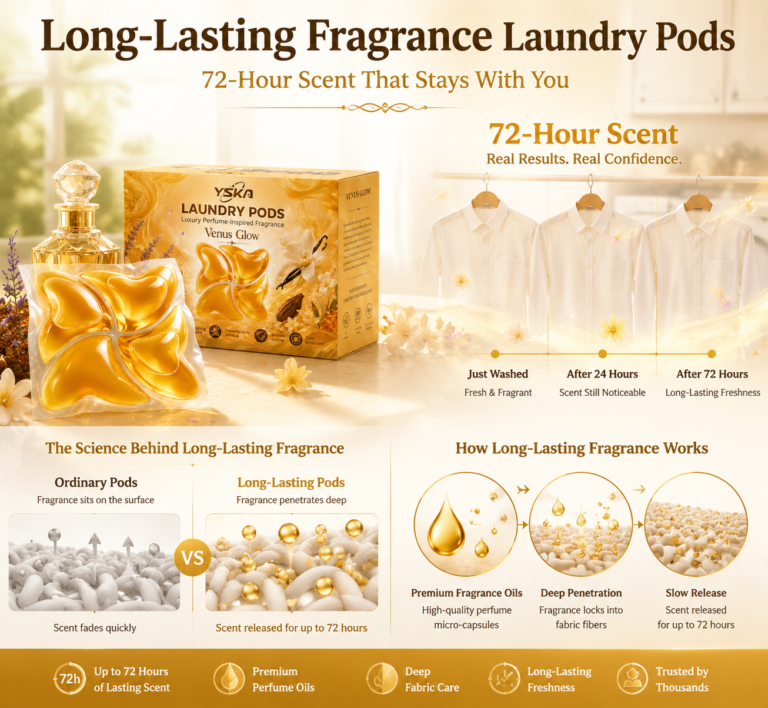
Some fragrance materials naturally remain on fabric better than others. Manufacturers may also use deposition systems or encapsulation technologies to protect selected scent materials and release them during drying, movement, or wear. The right approach depends on the target claim, formula, market, and cost.
Brands should ask specific questions rather than accepting the phrase “long lasting” at face value:
- Is the fragrance free oil, encapsulated fragrance, or a hybrid system?
- Which stage of the scent is designed to remain after drying?
- On which fabrics and wash programs was retention evaluated?
- Is the fragrance level compatible with the detergent and pod film?
- What evidence supports any 24-hour, 48-hour, or 72-hour claim?
More fragrance isn’t automatically better. Excess fragrance may affect formula stability, cleaning performance, film behavior, cost, or consumer comfort. The best perfume-inspired laundry pods use the right materials at justified levels, supported by repeatable tests.
2.6 Step 6: Run Structured Sensory and Performance Tests
Avoid approving a scent because one person likes it. Use a scorecard and compare coded samples under the same wash conditions. A small internal panel can rate package scent, wet-fabric scent, dry-fabric scent, character, intensity, cleanliness, uniqueness, and overall preference.
An example scorecard may look like this:
| Test Point | Timing | Score Range | What to Evaluate |
|---|---|---|---|
| Package opening | Before wash | 1-10 | Appeal, strength, premium character |
| Wet fabric | End of cycle | 1-10 | Freshness, off-notes, clarity |
| Dry fabric | After drying | 1-10 | Signature identity and balance |
| Stored fabric | 24-72 hours | 1-10 | Retention and character change |
| Re-wear or movement | After handling | 1-10 | Controlled release and pleasantness |
Test more than one fabric type when possible. Cotton, polyester, and blended textiles can hold or release scent differently. Also compare cold and warm wash programs if both are common in the target region. Record the pod dose, machine type, load size, water conditions, drying method, and evaluation time so results can be repeated.
2.7 Step 7: Approve and Lock a Master Scent Standard
Once the preferred sample is chosen, don’t approve it through a casual email such as “Sample B smells good.” Create a signed master standard with the fragrance code, detergent formula version, fragrance dosage, pod weight, color, film specification, packaging, and approved sensory profile.
The standard becomes the reference for incoming fragrance inspection and finished-product quality control. Retained samples should be stored under defined conditions and compared with new production batches. If the fragrance supplier changes a material because of availability, regulation, or an updated safety standard, the brand should review the change before production.
This step protects consistency. Without a locked standard, perfume-inspired laundry pods can drift over time. A product may become sweeter, weaker, more floral, or less persistent even though the name and packaging remain unchanged.
3. Engineering Perfume-Inspired Laundry Pods for Real-World Performance
A premium scent can’t compensate for weak cleaning, poor dissolution, leakage, or residue. The fragrance experience and the detergent system must be developed together. Consumers may love the first wash, but they won’t repurchase if the pod fails on stains or leaves marks on clothing.
3.1 Balance Cleaning Power and Fragrance Character
Surfactants and enzymes remove soil, but they also influence how a fragrance smells. Raw materials may have their own odors, while pH and solvent systems can change fragrance perception. The formulator needs to control the base odor before trying to create a fine-fragrance effect.
For perfume-inspired laundry pods, evaluate cleaning and scent side by side. A reformulation that improves stain removal could weaken the heart notes. A higher fragrance dose could create haze, viscosity changes, or interactions with enzymes. Each adjustment should be tested as part of the complete system.
Useful quality targets include:
- Stable appearance, color, and viscosity during the intended shelf life
- Reliable cleaning across common stains and water conditions
- No unacceptable fragrance distortion during storage
- Consistent dissolution at the labeled wash temperature
- Acceptable residue performance at the recommended dose
- Reproducible scent on wet and dry fabrics
3.2 Match the Pod Film, Formula, and Storage Conditions
Water-soluble film is sensitive to moisture and formulation compatibility. The manufacturer must match film grade, thickness, sealing conditions, and liquid composition. Poor control may lead to pods sticking together, softening, leaking, or dissolving too slowly.
Fragrance is one factor in this compatibility system. The development team should perform stability tests in the final pod format, not only in a bottle of bulk liquid. Test samples under the temperature and humidity conditions likely to occur during production, transport, warehousing, and consumer use.
Packaging also matters. A moisture-resistant container or pouch, reliable closure, clear dose instructions, and child-safety considerations protect both product performance and consumers. Premium design should never replace practical protection.
3.3 Design Claims Around Evidence
Words such as “luxury,” “premium,” and “perfume-inspired” describe positioning, but performance claims require evidence. If a brand says the scent lasts for a specific number of hours, it should define the test conditions and maintain supporting records. The same principle applies to cleaning, stain removal, biodegradability, sensitive-skin, antibacterial, or environmental claims.
Fragrance safety also depends on intended use and concentration. The International Fragrance Association guidance explains that a fragrance supplier’s Certificate of Conformity relates to a specified use and doesn’t replace the finished product’s safety assessment or local legal compliance. Brands should therefore request appropriate fragrance documentation and review the rules in every sales market.
According to IFRA’s current guidance, machine laundry detergents with skin contact are treated as Category 10A applications. Nevertheless, local detergent, chemical classification, packaging, labeling, and consumer-product rules still apply. A responsible OEM partner should help assemble documentation while making clear that the final brand owner and market operator also have compliance duties.
4. How OEM/ODM Manufacturing Turns a Scent Idea into a Product
An experienced OEM/ODM manufacturer connects fragrance development with detergent formulation, packaging, compliance, and production. This integrated workflow is especially useful for brands that have a strong creative direction but don’t own a detergent laboratory or filling line.
YCShinec’s OEM/ODM laundry care services provide a useful reference for the types of formula, fragrance, pod weight, packaging, and private label decisions that need to be coordinated.
4.1 Start with a Complete Development Brief
The buyer should provide more than a mood board. A practical brief includes target countries, consumer profile, fragrance direction, pod weight, chamber format, preferred color, cleaning functions, packaging type, target order volume, budget range, and launch date.
Add a list of non-negotiables and flexible items. For example, the scent identity may be fixed while the exact pod color is flexible. Or the packaging size may be fixed by a retailer, while the fragrance can be optimized for cost. This helps the OEM team protect what matters most when technical trade-offs appear.
4.2 Use a Controlled Sample Revision Process
Ask the factory to label every sample with a unique code and version date. Score each version against the same brief, then send consolidated feedback. Comments such as “make it more premium” are hard to act on. Better feedback is specific: “reduce the sharp citrus opening, keep the rose heart, and increase the clean woody-musk impression on dry cotton after 24 hours.”
Most projects need several revision rounds. That is normal. The goal isn’t to approve quickly; it is to make each round informative. Too many decision-makers can slow the process, so one person should collect comments and issue the final approval.
4.3 Verify Documents, Tests, and Market Readiness
Before placing a commercial order for perfume-inspired laundry pods, request a documentation pack appropriate to the destination market. The exact list will vary, but it may include a product specification, safety data information, ingredient or allergen disclosures where required, fragrance conformity documents, stability results, packaging specifications, batch records, and third-party test reports.
IFRA clarifies that it doesn’t issue an “IFRA certificate” itself. A Certificate of Conformity is prepared by the fragrance mixture supplier for a specified intended use, and it doesn’t replace a full safety assessment. Buyers can review the official IFRA explanation of fragrance conformity certificates when checking supplier documents.
If claims will appear on the label, define the test method before printing packaging. Otherwise, a brand may end up with thousands of finished boxes carrying a claim that hasn’t been properly supported.
4.4 Scale Up Without Losing the Approved Scent
A laboratory sample and a full production batch don’t always smell identical. Larger mixing vessels, raw-material addition order, temperature, mixing time, fragrance storage, and filling conditions can influence the finished product. That is why a pilot or pre-production batch is valuable.
During scale-up, control:
| Control Point | Why It Matters |
|---|---|
| Fragrance identity and lot | Prevents use of an incorrect or unapproved fragrance |
| Addition temperature and sequence | Reduces fragrance loss or distortion |
| Mixing time and uniformity | Keeps scent and active ingredients consistent |
| Pod fill weight | Controls dose, cost, and performance |
| Seal integrity | Reduces leakage during transport and storage |
| Finished sensory check | Confirms the production batch matches the master standard |
| Retained batch sample | Supports investigation if a later complaint occurs |
The supplier should also have a change-control procedure. No key fragrance, detergent, film, or packaging material should be substituted without review when it could affect the approved specification.
4.5 Protect Exclusivity and Confidential Information
Custom scent exclusivity can mean different things. A fragrance may be exclusive worldwide, exclusive only in one country, exclusive within laundry products, or exclusive for a defined period and minimum purchase volume. Put the scope in writing.
The agreement should identify who owns the fragrance brief, artwork, product name, formula improvements, test data, and finished fragrance code. It should also explain what happens if annual volumes aren’t met or a raw material must be replaced.
For smaller brands, full global exclusivity may be expensive. Category or regional exclusivity can offer a practical middle ground. The most important point is clarity before the product succeeds, because ownership questions become much harder after sales grow.
5. Positioning Custom Scents for Premium Laundry Brands
Perfume-inspired laundry pods need a story consumers can understand in seconds. Technical excellence is essential, but the front of the pack should communicate an emotional benefit, a distinctive scent name, and a clear product function.
5.1 Match the Scent Profile to the Market
Regional preferences aren’t fixed rules, but they provide a starting hypothesis for testing. Fresh citrus, airy florals, tea, and clean musk may suit brands seeking broad everyday appeal. Amber, oud-style woods, rose, spice, and vanilla can support richer luxury positioning. Lavender, eucalyptus-style freshness, soft woods, and herbal notes can fit wellness concepts.
Rather than assuming, test two or three directions with target buyers. Ask what each scent communicates, when they would use it, what price they expect, and whether it feels different from current products. Preference scores alone aren’t enough. A scent can be pleasant but forgettable, while a more distinctive option may create stronger loyalty.
5.2 Name the Scent Without Borrowing Another Brand
Strong names describe an original world: “White Cedar Morning,” “Velvet Rose Linen,” “Coastal Mineral Air,” or “Amber Cashmere Night.” These names give designers and copywriters material for color, photography, and storytelling.
Avoid using a famous perfume name, a confusingly similar spelling, or phrases such as “our version of.” Also avoid promising that clothes will smell exactly like a protected fragrance. The better message is that the product applies fine-fragrance structure and premium scent design to fabric care.
For additional positioning ideas, see the guide to launching a perfume-grade laundry pod brand. It can help connect scent development with packaging, sampling, and channel strategy.
5.3 Build a Coherent Scent Portfolio
Launching ten scents at once may sound impressive, but it complicates inventory, packaging, demand forecasting, and marketing. Many new brands are better served by three clear choices:
- The accessible signature: Clean, modern, and broadly appealing.
- The expressive hero: More distinctive and strongly connected to the brand story.
- The seasonal or regional edition: Designed for a specific mood, market, or sales period.
Each scent should have a job. If two options communicate the same mood and smell very similar, they may divide sales instead of growing the range. Start focused, collect repeat-purchase data, and expand from evidence.
6. How to Choose the Right Perfume-Inspired Laundry Pods Supplier
The best supplier isn’t simply the factory offering the longest scent list or lowest price. A premium brand needs a partner that can translate creative language into controlled production and explain the trade-offs clearly.
6.1 Evaluate Fragrance and Laboratory Capability
Ask whether the manufacturer has in-house formulators, a defined sample process, stable fragrance-house relationships, wash-testing equipment, retained samples, and documented quality standards. Request examples of how the team solved a past scent stability or detergent compatibility problem, without asking them to reveal another customer’s confidential formula.
Review physical samples under your own wash conditions. A presentation box and blotter evaluation are useful, but washed fabric is the real product experience. Compare sample consistency across separate production dates if possible.
6.2 Ask Commercial Questions Before Paying a Deposit
Clarify the minimum order quantity for each formula, scent, pod color, package size, and artwork version. One total MOQ may hide several component minimums. Also ask about sample fees, fragrance development fees, printing plates, testing costs, lead times, payment stages, acceptable quality limits, inspection rights, and replacement terms.
Use the site’s detailed laundry pods OEM FAQ as a starting checklist, then request a written quotation based on your actual specification. If you’re comparing suppliers, provide the same brief to each one so the quotations are genuinely comparable.
6.3 Look Beyond the First Order
Premium laundry brands depend on repeatable supply. Ask how the factory manages fragrance lot changes, raw-material shortages, seasonal demand, export documents, complaint investigations, and reorders. A slightly lower first-order price may not be worthwhile if the scent changes or delivery becomes unreliable.
Perfume-inspired laundry pods create loyalty only when the customer receives the same satisfying experience every time. Consistency is therefore part of the brand promise, not merely a production detail.
7. Frequently Asked Questions About Perfume-Inspired Laundry Pods
7.1 What makes perfume-inspired laundry pods different from ordinary scented pods?
Ordinary scented pods often use a simple fragrance intended mainly to signal cleanliness. Perfume-inspired laundry pods use a more structured scent concept with a defined opening, heart, and base. They are developed to create a recognizable brand identity on fabric, while still meeting cleaning, dissolution, stability, and safety requirements.
7.2 Can a manufacturer copy a famous luxury perfume exactly?
A manufacturer may be technically able to analyze a scent direction, but premium brands should not build products around copying another company’s protected identity. A safer strategy is to describe the desired fragrance family, mood, note structure, and performance, then commission an original composition. Obtain legal advice for trademarks, comparative advertising, and packaging in each target market.
7.3 How long does custom scent development take?
Timing depends on the clarity of the brief, number of scent directions, revision rounds, formula complexity, testing, packaging, and documentation. A stock fragrance can move quickly, while a new exclusive composition with extended stability and market testing will take longer. Ask the OEM partner for a stage-by-stage schedule rather than one general delivery promise.
7.4 What is the typical MOQ for a custom fragrance?
MOQ depends on the fragrance house, detergent formula, pod format, packaging, and production line. A standard formula with a selected scent usually has a lower minimum than a fully exclusive fragrance and custom multi-chamber pod. Confirm separate minimums for fragrance concentrate, printed packaging, colors, and finished pods before budgeting.
7.5 Are stronger fragrances always more premium?
No. Strength and quality aren’t the same thing. An overly strong scent may feel harsh, mask poor balance, or reduce appeal among fragrance-sensitive consumers. Premium scent design focuses on clarity, evolution, fabric character, and appropriate intensity. The preferred level should be established through controlled wash tests with the target audience.
7.6 Can perfume-inspired laundry pods be developed for sensitive consumers?
It may be possible to create a lower-intensity or carefully selected fragrance direction, but no fragranced product should be assumed suitable for every sensitive consumer. Ingredient selection, exposure, labeling, finished-product assessment, and local regulation matter. Brands considering this segment should work with qualified safety and regulatory specialists and avoid unsupported “hypoallergenic” claims.
7.7 What documents should a premium laundry brand request?
The list varies by market, but buyers commonly request the approved product specification, relevant safety information, fragrance documentation for the intended use, stability and performance results, batch or quality records, packaging specifications, and evidence supporting label claims. Confirm requirements with a local compliance professional before import or sale.
7.8 How can a brand keep its custom scent consistent across batches?
Approve a coded master standard, define fragrance dosage and formula version, retain samples, control fragrance lots, conduct sensory checks, and require written change notification. The OEM agreement should state that key fragrance or formula materials can’t be substituted without review when the change could affect the approved product.
8. Conclusion: Turn Fragrance into a Defensible Brand Asset
Perfume-inspired laundry pods give premium laundry brands a powerful way to combine practical cleaning with emotion, ritual, and identity. Yet the winning product is not simply the strongest-smelling pod. It is an original scent designed for a clear consumer, engineered for a concentrated detergent system, evaluated on washed fabric, supported by appropriate documentation, and reproduced consistently at scale.
The seven-step process is straightforward: define the audience, create an ownable scent territory, build a fabric-focused fragrance pyramid, adapt it to the detergent base, optimize deposition, test performance, and lock a master standard. When those steps are connected to disciplined OEM/ODM manufacturing, the fragrance can become a genuine business asset rather than a short-lived marketing idea.
Brands ready to develop perfume-inspired laundry pods should begin with a written brief and a small, controlled sample program. Compare scents under realistic wash conditions, verify the supplier’s technical and quality systems, and finalize claims only after the supporting evidence is available.
To discuss fragrance direction, pod weight, formula functions, packaging, testing, and private label production, contact YCShinec for custom OEM/ODM samples and a quotation.
*Post-Article Message: Thank you for reading this complete guide to perfume-inspired laundry pods. We hope it helps your team turn a fragrance idea into a distinctive, consistent, and commercially viable premium laundry product. Follow the YCShinec blog for more practical guidance on custom laundry formulations, private label development, fragrance performance, packaging, sourcing, and OEM/ODM production.