Leave A Message
Tips: Kindly notice that reply of inquiry via email may went into spam, please kindly check your spam if you have sent inquiry email and do not receive replies, thank you.

Single-chamber and multi-chamber laundry pods serve different product goals. Compare formula compatibility, seal reliability, dissolution, fragrance, packaging, MOQ and cost per wash before choosing an OEM design.
Comparing single vs multi chamber laundry pods is a product-design exercise, not a shortcut to better cleaning. One chamber can suit a focused formula and a clear price target. Multiple chambers can create a distinctive appearance and may keep selected formula phases apart until the wash, when separation has a tested purpose. For a private-label launch, compare the finished formula, seal reliability, dissolution, fragrance experience, packaging, and cost per wash under the same conditions before choosing either format.
Planning a private-label range? Ask SHINEC about available pod designs and sample options. Share your target market, wash load, fragrance direction, pack count, and desired shelf price so the discussion starts with a useful brief.
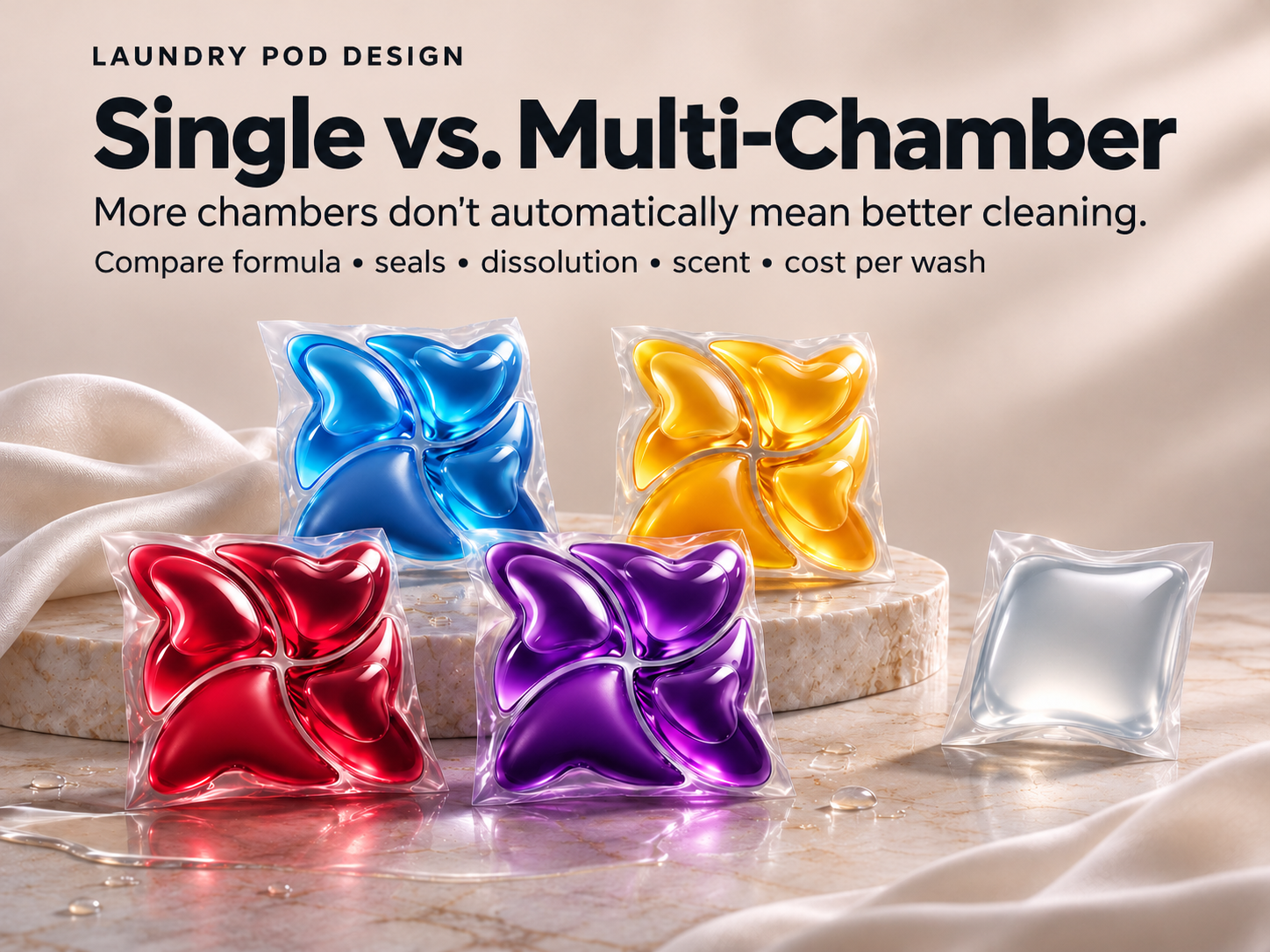
A chamber is a sealed space inside a water-soluble film packet. A single-chamber pod holds its contents in one cavity. A multi-chamber pod divides the dose into two or more cavities, often with a visible pattern of colors or shapes. The divisions are part of the packet design; they do not, by themselves, tell a buyer what the formula will do in a washing machine.
The phrase single-load describes a premeasured dose, not the number of chambers. A pod can be single-load and still have several chambers. Likewise, chamber count does not reveal the weight of a pod. A single-chamber 10 g concept and a four-chamber 20 g concept differ in more than geometry. They may use different formulas, films, equipment settings, packaging, and recommended doses.
When you compare supplier samples, record the chamber count, total fill weight, fill weight by chamber if relevant, film specification, target wash load, and intended sales channel. Without these details, a photograph of two pods is only a design comparison.
The strongest technical reason for multiple chambers is a documented need to separate ingredients or liquid phases during storage. Some combinations may affect stability, color, scent, or viscosity when held together. Separate cavities give a formulator another design option, but the benefit depends on the actual ingredients, their concentrations, the film, and the storage conditions.
Ask the supplier to explain the purpose of each chamber in plain language. Is a separate phase meant to protect a fragrance component, maintain a color effect, manage compatibility, or simply create a visual pattern? What comparative testing supports that choice? If the formula performs and remains stable in one chamber, a more complex packet may add cost without adding value for your buyer.
Do not assume that putting three colors in three chambers creates three cleaning functions. A color is not a performance specification. Request the complete product specification and test method for any cleaning, color-care, or fragrance claim you intend to print on a package. If a claim cannot be tied to the proposed formula and a relevant test, leave it out of the launch brief.
The number of chambers alone cannot establish stain removal, fabric care, or cleaning power. Those outcomes depend on the dose, active ingredients, water conditions, wash cycle, soil, fabric, and the way the packet opens and dissolves. A larger or more colorful pod is not automatically a stronger pod.
For an OEM comparison, test the two proposed products at the same intended dose and with the same conditions. Choose soils that matter to your customer, such as everyday food stains or body oils, and include the fabrics and machine settings common in your target market. Define what “better” means before testing: visible stain removal, residue, fragrance perception, or another measured result. A supplier should be able to tell you which sample and test conditions produced each result.
Compare cost per usable wash, not just cost per packet. If one format requires a different dose for the same target load, price per pod can mislead. Also consider the end user’s instructions: an attractive pod with confusing dosing guidance can create complaints that have nothing to do with the formula’s laboratory performance.
Multi-chamber structures can make a product visually recognizable through shape and color placement. That can matter for a premium perfume-laundry-pod range where packaging, scent story, and shelf presentation work together. A single-chamber pod can still look premium through thoughtful color, fragrance, pack design, and reliable product experience.
SHINEC’s four featured perfume-pod concepts—Beloved, Venus Glow, Sovereign, and Polar Zone—illustrate distinct red, gold, purple, and blue visual directions. These are useful starting points for a brand discussion about color and scent identity. The concept imagery accompanying this article is illustrative; it should not be read as a photograph of a production batch, a formula diagram, or proof of performance.
Fragrance evaluation needs more than a first impression from an open packet. Ask for matched samples and evaluate the scent in the packet, during the wash, and on dry fabric at a defined time. Use the same fabric, water, dose, and drying conditions for each sample. A pleasant scent in the pouch may change after washing, while a subtle scent in the pouch may be more noticeable on clean fabric. If you plan a longevity claim, define and validate its measurement before printing it.
Each chamber adds edges and junctions that must be sealed consistently. A complex shape may have more opportunities for a weak seam, uneven fill, or cosmetic variation. This does not mean a multi-chamber pod is inherently leaky; it means the design has to be validated as a complete packet on the intended line.
Request samples from the proposed production process, not only hand-made presentation samples. Examine seam continuity, fill consistency, deformation, sticking, and visible leakage after handling and storage. If a sample is damaged, ask whether the cause was the formula, film, sealing conditions, humidity exposure, or packaging. Changing one factor at a time makes troubleshooting more useful.
Dissolution should be assessed in the wash conditions printed on the final label. Water temperature, cycle length, load size, and placement in the drum can all affect the experience. A good sample check records whether the film opens, whether contents disperse, and whether visible residue remains under the chosen conditions. The American Cleaning Institute’s packet guidance recommends placing a single-load liquid laundry packet in the drum before clothes and following the product label. Your final instructions should match the validated product and market.
The manufacturing discussion goes beyond the number of cavities. Ask whether an existing mold and line can produce the requested shape, weight, and chamber layout. A standard option may be simpler to sample and quote than a new custom geometry. Changes in fill volume, film, color placement, or seal pattern may require a different setup or additional process validation.
See the manufacturing step: Watch SHINEC’s laundry-pod liquid injection system. This 49-second factory video shows the filling equipment in operation; it does not establish the performance of any specific chamber design.
For a brand owner, this means a drawing is only the start. Request a production-feasibility review of the exact combination you want: total grams, chamber count, formula, fragrance level, color, film, and package. If a supplier shows a concept image, ask which elements are already in production and which need development. A beautiful render is not evidence that a chosen design has passed shelf-life or transport checks.
The first production run can also reveal differences that a small bench sample misses. Agree on acceptable appearance and weight tolerances, inspection points, and the reference sample before scale-up. SHINEC’s general workflow includes pre-production sample approval, in-process checks, and shipment checks; the exact acceptance criteria should be agreed for your order.
There is no honest universal rule that a multi-chamber pod always costs a fixed percentage more, or that every single-chamber design has the same minimum order quantity. Price and MOQ depend on the selected formula, chamber layout, fill weight, film, mold availability, packaging, artwork, production run, and commercial terms. A new shape may have a different setup cost from an existing design.
Ask for comparable quotations built around the same commercial brief. If you change both the pod and the pack at once, you will not know which decision caused the price difference. Request each quote to show the unit basis, pack count, total pod weight, formula scope, packaging type, artwork or tooling charges, sample cost, applicable quantity breaks, lead-time assumptions, and Incoterm. Clarify whether the figure is per pod, per retail pack, or per carton.
| Decision point | Single-chamber option | Multi-chamber option | What to verify |
|---|---|---|---|
| Formula | One cavity may suit a compatible, focused formula. | Separate cavities may support a specific formulation or visual goal. | Written formula brief and stability evidence. |
| Visual design | Simple shape can still support a strong brand. | Multiple shapes and colors may create a distinctive look. | Production samples, not renders alone. |
| Process | Existing mold and line setup may be straightforward. | Layout and sealing may require more setup or validation. | Available mold, equipment, tolerances. |
| Cost | Depends on dose, formula, film, pack, and volume. | Depends on the same factors plus the chosen structure. | Like-for-like landed and per-wash comparison. |
| MOQ | Quote-specific. | Quote-specific. | MOQ by formula, shape, fragrance, and packaging SKU. |
| Risk checks | Seal, storage, leakage, and dissolution still matter. | The same checks plus chamber-junction consistency matter. | Agreed sample and transport test plan. |
Need a like-for-like comparison? Request design options and a tailored quote for one target market and one pack format. Ask the team to identify which variables change between the options.
“Multi-chamber takes longer” may be true for a new custom design and false for an established design that is already running. The relevant question is whether your exact formula, shape, film, and packaging have been approved for production. Ask separately for time needed for development samples, sample approval, packaging artwork, production, inspection, and shipment. A single headline lead time hides these dependencies.
Build a buffer for revisions. A fragrance may need adjustment after a wash test, or a colored chamber may need a different appearance tolerance. If your label needs market-specific warnings or language, complete that work before committing to print. For a first launch, a proven structure with a distinctive fragrance and package can be a practical way to reach market while a custom geometry is developed in parallel.
Record the final approved sample and specification. If you later switch a fragrance, color, film, or pack, ask whether the change affects stability, dissolution, or labeling. Treat every material change as a new review point rather than assuming that approval of one variant covers the whole range.
A value-focused retail line may favor a clear dose, reliable cleaning, and straightforward pricing. A premium perfume-pod line may put more emphasis on fragrance identity, visual presentation, and the unboxing experience. An ecommerce brand also needs packaging that travels well; a display-led store brand may prioritize shelf recognition. These are commercial priorities, not properties automatically delivered by chamber count.
Write a one-page buyer profile before requesting samples. Include the target customer, channel, target retail price, intended wash load, main cleaning expectation, fragrance direction, pack size, and markets. Then state the non-negotiable checks: leak resistance, dissolution, storage stability, labeling, and packaging integrity. Your supplier can propose a single- or multi-chamber format against that brief.
If you plan several fragrance SKUs, ask whether each scent can use the same base structure and packaging dimensions. Consistency may simplify merchandising and replenishment. Yet each fragrance variant should still be checked for compatibility and stability in its own right; a shared mold does not make every formula identical.
Use matched samples where possible and write down the conditions. A sample that merely looks good on a desk does not answer the most important launch questions.
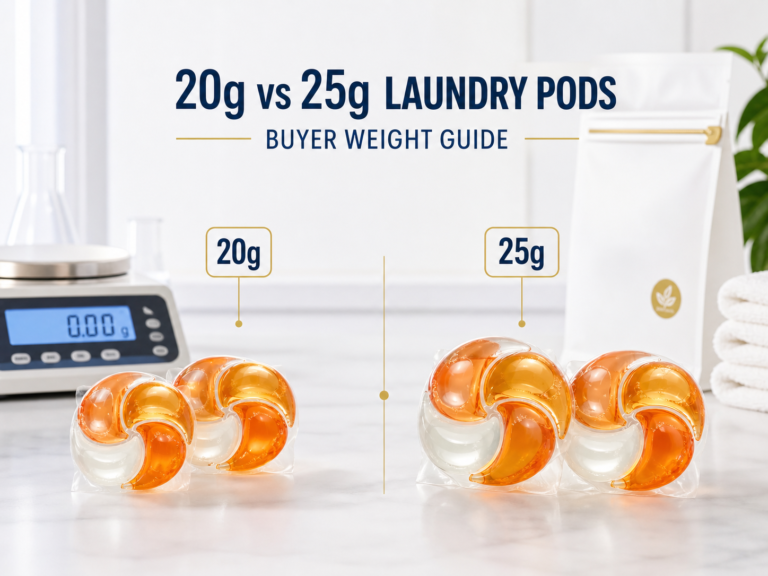
For more detail, see our guides to testing laundry pod samples and comparing 20 g and 25 g pods. These decisions are connected: chamber architecture and total dose should be reviewed together, not confused with one another.
Whether a pod has one chamber or several, it must be sold with instructions and packaging appropriate to the destination market. Consider moisture protection, closure, child access prevention, storage advice, and clear use directions early in the project. A packet may pass a wash test yet disappoint customers if the pouch does not close well or the pods stick together in storage.
The U.S. Consumer Product Safety Commission’s liquid laundry packet page identifies a voluntary safety standard for the category. Requirements differ by market and may change, so ask a qualified local adviser or importer to review the final formula, packaging, claims, and warnings for the country of sale. Do not assume that a supplier’s general certificate or a concept label clears every destination market.
Consumer directions should tell buyers to keep packets in their original closed container, out of children’s reach, and to follow the label. The final wording and packaging should be checked against applicable market rules. Safety is part of the product specification, not a decorative icon added at the end.
A precise inquiry saves rounds of vague quotes. Send your target market, estimated order range, desired price position, sales channel, preferred pack size, wash load, fragrance direction, and whether you prefer an existing design or a custom shape. Attach your reference images, but say which details are essential and which are only inspiration.
Ask for two options if you are undecided: one existing single-chamber design and one feasible multi-chamber design that can serve the same buyer brief. Request the differences in formula approach, chamber layout, sample plan, production readiness, pack compatibility, MOQ, and quoted price basis. This makes the conversation about trade-offs you can actually approve.
If the product will be private label, share the brand’s desired positioning and labeling language early. Packaging artwork, claims review, and product testing need to describe the same final SKU. For related steps, read SHINEC’s OEM/ODM service overview and private-label cost guide.
No. The better choice is the one that meets the intended cleaning, fragrance, safety, stability, visual, and price targets. Multiple chambers can support a justified formula separation or design goal, but they do not automatically improve cleaning. Compare finished samples under the same conditions.
Yes. A premium position can come from a well-designed formula, a distinctive fragrance, consistent quality, clear dosing, and strong packaging. Chamber count is one design choice among many. Ask customers what they value rather than treating a complex appearance as proof of value.
No fixed rule applies across suppliers and designs. An existing multi-chamber mold may have a different minimum from a newly developed single-chamber formula or a custom printed pack. Request MOQ separately for each formula, shape, fragrance, and packaging SKU.
Not necessarily. Fragrance perception depends on fragrance composition, dose, formula, storage, wash, fabric, and how the scent is evaluated. Chamber separation may be useful for a specific design, but any longevity claim needs a defined test on the final SKU.
Neither format can be ranked without samples and process data. Film compatibility, seal quality, fill level, handling, humidity, and packaging all matter. Multi-chamber junctions require careful validation, while single-chamber seams require it too. Test the proposed production sample and packaged product.
You can ask for a fragrance change, but approval should be revisited. A new fragrance may affect compatibility, color, stability, or how the scent performs after washing. Request an updated sample and confirm whether the specification or label needs to change.
Start with the buyer brief rather than a number. If a simple compatible formula and fast-to-explain value proposition fit the market, an existing single-chamber option may be sensible. If visual identity or documented formula separation is central, test a feasible multi-chamber option. Compare total launch cost and risk for both.
First verify that each sample is clearly identified and physically sound. Then run a matched wash under your intended label conditions, recording dissolution, residue, cleaning, and fragrance. Follow with storage and packaged-transport checks before approving a commercial SKU.
Single-chamber and multi-chamber laundry pods can both be appropriate OEM choices. The winning format is the one whose formula, packet, fragrance, packaging, and price work together for your customer—and whose quality can be repeated at production scale. Use the chamber count to define a testable design brief, then approve the final SKU on evidence rather than appearance alone.
Ready to compare options? Contact SHINEC to request design options and matched samples. Tell us your target market, preferred fragrance direction, pack size, and launch goals; we can discuss a practical sample plan before you commit to a structure.