Leave A Message
Tips: Kindly notice that reply of inquiry via email may went into spam, please kindly check your spam if you have sent inquiry email and do not receive replies, thank you.

Buyers comparing import laundry pods from China should use one written specification for every supplier. The specification should identify the formula direction, unit format, package, target market, test conditions and acceptance criteria.
The approved import laundry pods from China sample should have a code and date. Before ordering import laundry pods from China, confirm that the quotation, artwork and test evidence refer to that same version. For import laundry pods from China projects, any later formula, fragrance, film or packaging change should require written buyer approval.
import laundry pods from China successfully, buyers need a product specification, verified supplier, approved sample, destination-market compliance plan and clear shipping responsibilities. Price comparison should begin only after these commercial and technical requirements match.
Before placing the order, confirm the legal supplier, formula and pod specification, packaging artwork, test scope, inspection criteria, Incoterm, landed-cost assumptions, shipping documents and post-shipment traceability. Use current advice from your customs broker and responsible market operator.
For product-safety context, review the official CPSC liquid laundry packet guidance. Market requirements and claim evidence must still be confirmed for the exact formula, package and destination.
To import laundry pods from China successfully, buyers need to manage more than factory price and freight. The order must connect a clear product specification, a verified manufacturer, destination-market compliance, tariff classification, packaging, shipping documents, quality control, and a realistic landed-cost model.
This buyer guide is written for brand owners, distributors, retailers, and importers using OEM/ODM or private-label production. It does not promise a fixed saving because actual cost depends on the formula, pod weight, packaging, order quantity, route, duties, local charges, and sales channel.

Start with the country of sale and a written product brief. Customs, labeling, chemical requirements, language, packaging, and claims are market-specific. A quotation is difficult to compare when suppliers are pricing different pod weights, chamber structures, fragrances, pack counts, and package materials.
For a new private-label project, review the private-label laundry pods process before requesting quotations.
Confirm the legal company name, business registration, factory address, production scope, quality-control process, export experience, capacity, and who owns the formulas and packaging files. A polished catalog does not prove manufacturing capability.
Ask for a live factory video call or an on-site audit when the order risk justifies it. Review production lines, raw-material controls, film and fragrance storage, weighing controls, leak detection, finished-goods inspection, batch coding, retained samples, and complaint handling. Use our OEM laundry pod factory selection guide as a due-diligence checklist.
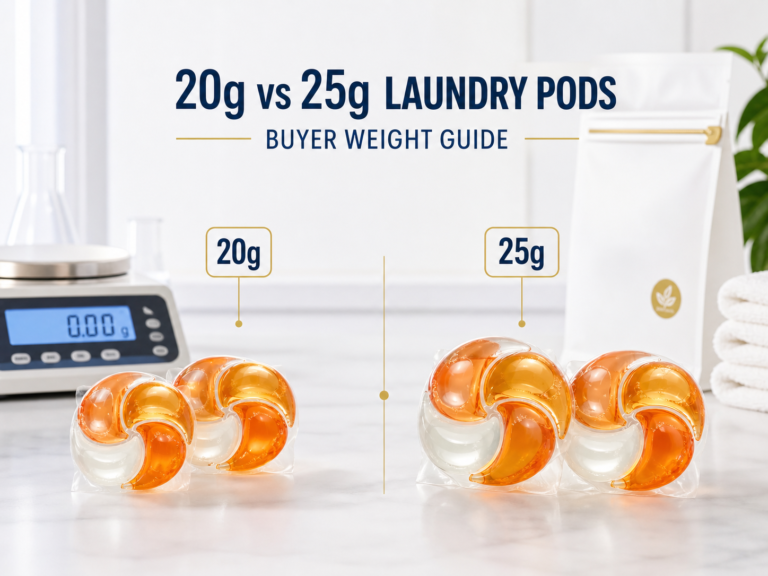
Compare like with like. A low unit price may reflect a lighter pod, lower fragrance dosage, simpler film structure, fewer chambers, thinner packaging, a different pack count, or excluded printing and testing costs. Request a line-by-line quotation that identifies the formula version, pod specification, package specification, MOQ, tooling or plate fees, sample charges, testing charges, lead time, Incoterm, and quotation validity.
| Cost Item | What to Confirm |
|---|---|
| Product | Pod weight, chambers, formula, fragrance, film, and quantity |
| Packaging | Bag, tub, or box; pack count; print method; cartons; pallets |
| Development | Samples, revisions, fragrance matching, artwork, plates, and molds |
| Testing | Which tests are included, laboratory, sample version, and report ownership |
| Logistics | Incoterm, origin charges, freight, insurance, destination charges, and delivery |
Test the complete system: formula, water-soluble film, fragrance, chamber design, and final package. Check cleaning performance, dissolution, residue, leakage, seal strength, fragrance before and after drying, storage stability, temperature exposure, package closure, and transport resistance. The sample should match the written specification and intended washing conditions.
Keep one signed reference sample with the buyer and one with the factory. Record every approved change. Follow the 15-point laundry pod sample checklist before issuing a bulk purchase order.
Request documents for the actual formula and packaging version you intend to import. Depending on the market and product, the file may include a product specification, Safety Data Sheet, ingredient information, test reports, supplier declarations, packaging information, batch records, and label data. A generic certificate from another formula is not enough.
Claims such as antibacterial, hypoallergenic, eco-friendly, non-toxic, child-safe, or biodegradable require separate evidence and may trigger additional rules. Review our US and EU laundry pod compliance guide, then have the final formula, claims, and label reviewed for the destination country.
Laundry detergent preparations are commonly considered within Harmonized System heading 3402, but the final national code cannot be selected from a blog post alone. Classification can depend on composition, presentation, retail packaging, and the importing country’s tariff subdivisions. The code determines duty treatment and can also connect to non-tariff measures.
Use official tariff tools as the starting point: the United States Harmonized Tariff Schedule, the EU CLASS and TARIC information system, or the Canada Customs Tariff 2026. Obtain written confirmation from a licensed customs broker or request an advance or binding ruling when uncertainty or order value makes that appropriate.
Do not use factory price as the profitability estimate. Calculate product and packaging cost, development fees, testing, inland transport, export handling, freight, insurance, duty, import taxes, customs brokerage, port or terminal charges, inspection, delivery, warehousing, financing, returns, and a contingency allowance. Use current quotations for the actual route.
Compare at least two shipment scenarios using the same assumptions. The cheapest freight quote is not necessarily the lowest landed cost if it excludes origin or destination charges, has a long transit time, or creates higher inventory risk.
Write the Incoterm and named place into the quotation and purchase order. Clarify who books freight, handles export clearance, buys insurance, provides shipping documents, pays origin charges, acts as importer of record, and pays destination charges. Buyers should understand the responsibility split rather than selecting EXW, FOB, CIF, or DDP only by headline price.
Provide the freight forwarder with the current product specification, Safety Data Sheet, package details, carton dimensions, gross weight, and shipment quantity. The forwarder or carrier determines transport acceptance using the actual product and route; an SDS alone should not be treated as a universal shipping approval.
The purchase order should reference the approved sample, formula version, artwork files, pod weight tolerance, chamber design, fragrance, film, package materials, pack count, carton marking, batch code, quantity, inspection criteria, documents, lead time, Incoterm, and payment terms. Agree in writing on how nonconforming goods will be handled.
Ask the broker and forwarder for the exact document list before the cargo leaves the factory. Common commercial documents include the commercial invoice, packing list, bill of lading or air waybill, and country-of-origin information where required. Product-specific or market-specific documents depend on the destination, formula, claims, and shipment.
Check that the company names, addresses, product description, quantity, weights, values, Incoterm, marks, and classification information are consistent across documents. Resolve discrepancies before filing or loading whenever possible.
A supplier can provide composition, specification, suggested classification information, and past export experience. The importer remains responsible for correct entry in the destination country. Confirm the national code with a qualified broker or customs authority.
There is no defensible universal percentage. Savings depend on the product specification, MOQ, packaging, freight, duties, local charges, inventory, quality risk, and your alternative source. Compare full landed cost using current written quotations.
At minimum, confirm the supplier identity, quotation, product brief, approved sample status, specification, packaging plan, test and document responsibilities, lead time, inspection plan, Incoterm, payment terms, and remedy for nonconforming goods.
The safest way to import laundry pods from China is to make every commercial and technical assumption visible before production. Verify the factory, compare equivalent specifications, test samples, confirm classification and compliance, calculate landed cost, lock quality criteria, and prepare documents early.
To discuss a private-label or luxury fragrance laundry pod project, contact SHINEC with your destination market, target specification, pack count, expected order quantity, and launch schedule.
The following SHINEC factory images provide production, laboratory and quality-control context. Buyers should still verify the exact line, sample and document scope for their selected product.