-
Tel : +8613829237316
-
Email : solara@ycshinec.com

How to Test Laundry Pod Samples Before Bulk Production: A 15-Point Buyer Checklist

A laundry pod sample can look impressive on a desk and still fail in the market. The film may become sticky during storage. The fragrance may smell strong inside the package but disappear after drying. A beautiful multi-chamber pod may leak during transport, leave residue in cold water, or arrive in bulk with a different color and scent from the approved sample.
That is why buyers should test laundry pod samples under controlled conditions before approving bulk production. A proper test does more than ask, “Does it clean?” It checks whether the sample matches the agreed specification, performs in the target market, survives storage and shipping, supports the intended claims, and can be reproduced consistently at factory scale.
This guide provides a practical 15-point buyer checklist for evaluating private-label and OEM laundry pod samples. It is especially useful for brands developing high-weight, multi-chamber, or perfume-inspired products for North American, South American, African, and other international markets.
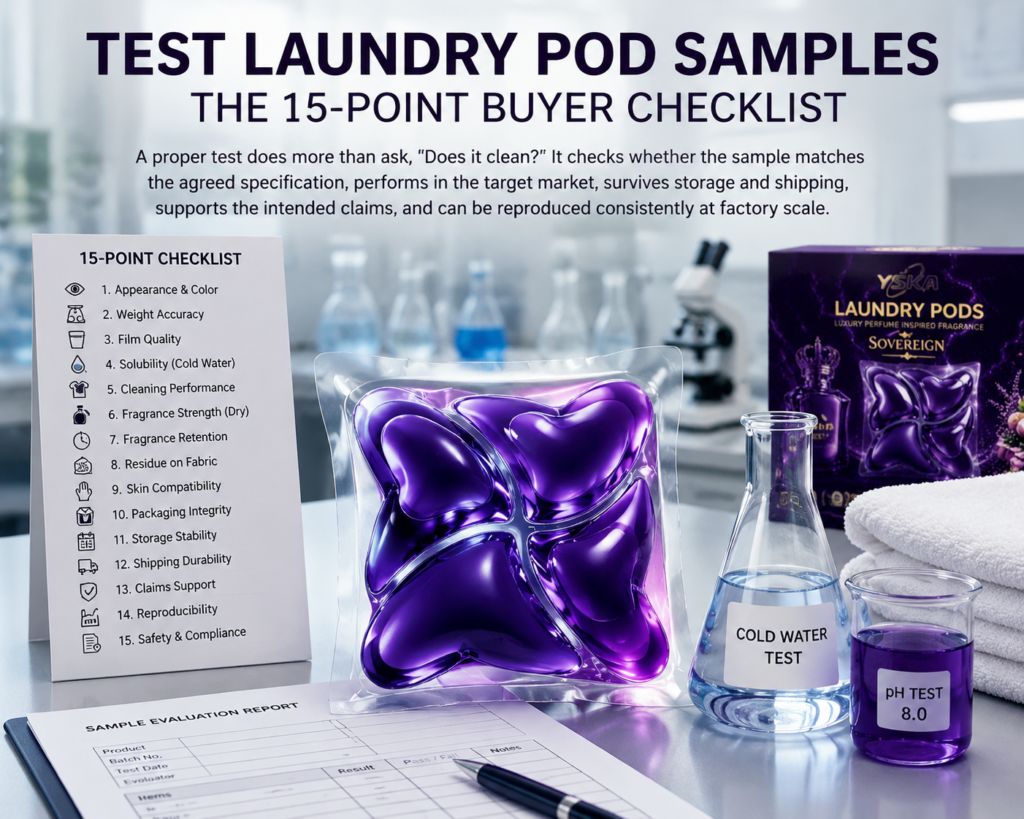
1. Why Laundry Pod Samples Must Be Tested Before Bulk Production
Laundry pod samples combine concentrated detergent, water-soluble film, seals, fragrance, colorants, enzymes, and packaging in one system. These parts affect each other. A fragrance adjustment can influence formula stability. Higher liquid fill can put more pressure on the seal. Humidity can soften the film. A packaging closure that works in a dry showroom may not protect the product in a humid warehouse.
For that reason, laundry pod samples should be evaluated as complete product systems rather than one feature at a time.
1.1 A Presentation Sample Is Not Automatically a Production Standard
Suppliers may provide different types of samples during development:
- Stock sample: An existing formula used to demonstrate the supplier’s general capability.
- Customized laboratory sample: A small run adjusted for your fragrance, color, weight, chamber design, or performance target.
- Pre-production sample: A sample produced using conditions closer to the intended production process.
- Pilot-batch sample: A limited factory run used to confirm scale-up, packaging, and batch consistency.
- Golden sample: The final approved reference retained by both buyer and manufacturer.
Ask the supplier to state which type you are receiving. Stock laundry pod samples can help you screen suppliers, but they should not become the sole basis for approving a customized order. If your project includes a custom scent, special 20g or 25g fill weight, multi-chamber appearance, or branded packaging, test a representative pre-production or pilot sample before authorizing the full run.
Buyers exploring these options can review YCshinec’s OEM/ODM laundry care services and private-label laundry pod process before defining the sample brief.
1.2 Testing Protects More Than Product Quality
A structured approval process reduces several commercial risks:
- Customer complaints: Leakage, residue, weak scent, excessive foam, or poor stain removal can quickly damage reviews.
- Claim risk: Packaging claims should match available test evidence and local requirements.
- Inventory risk: A minor defect becomes expensive when repeated across a full container.
- Brand inconsistency: Color, perfume character, pod shape, and package presentation must remain recognizable from batch to batch.
- Launch delays: Clear pass/fail criteria prevent repeated subjective revisions late in the project.
- Supplier disputes: Written specifications and retained samples provide a common reference when results differ.
The goal is not to create an academic laboratory for every order. The goal is to make the decision traceable. A buyer should be able to explain what was tested, how it was tested, what passed, what failed, and which sample became the final production reference.
2. How to Prepare Fair and Repeatable Tests for Laundry Pod Samples
Results are difficult to compare when laundry pod samples are washed under different conditions. Before opening the first package, create a simple test protocol. Use the same procedure for every supplier and record exceptions.
2.1 Record the Identity of All Laundry Pod Samples
Assign all laundry pod samples a code rather than relying only on the supplier’s product name. Record:
- Supplier and factory name
- Sample code and date received
- Formula or version number
- Production or laboratory batch number, if available
- Nominal unit weight
- Number of chambers
- Fragrance name or code
- Film type or grade stated by the supplier
- Package type and quantity
- Intended market and wash conditions
- Whether the sample is stock, customized, pre-production, or pilot-batch
Photograph the unopened package, label, individual pods, and any visible damage on arrival. Keep several unopened units as retain samples. This small step is useful if the tested laundry pod samples later behave differently from the retained units.
2.2 Standardize Wash Conditions for Laundry Pod Samples
Cleaning and dissolution results from laundry pod samples change with water temperature, water hardness, machine type, load size, fabric, and cycle length. Define the conditions that reflect your actual customers.
At minimum, record:
| Test Variable | What to Control |
|---|---|
| Machine | Front-load or top-load; model or capacity |
| Water temperature | Cold, normal, and warm settings relevant to the market |
| Water hardness | Local reading or a consistent water source |
| Load | Total dry weight and fabric mix |
| Soil level | Light, normal, or a repeatable stained-swatches set |
| Dosage | One pod, two pods, or the proposed label instruction |
| Cycle | Program name, duration, rinse count, and spin speed |
| Drying | Air-dried or tumble-dried under the same conditions |
One perfect wash proves very little. Repeat important tests and include at least one challenging but realistic condition, such as cold water, a short cycle, or a full normal load.
2.3 Define Pass, Conditional Pass, and Fail Before Testing
Agree on the decision rules before the team smells or washes the laundry pod samples. Otherwise, an attractive fragrance or low quotation can quietly change the standard.
- Pass: Meets the written requirement without corrective action.
- Conditional pass: Acceptable only after a documented adjustment or additional evidence.
- Fail: Creates a safety, compliance, leakage, dissolution, cleaning, or repeatability concern.
Use both mandatory gates and scored preferences. For example, no leakage and acceptable dissolution may be mandatory, while color attractiveness and fragrance preference may be scored. A supplier should not compensate for a leaking pod with a lower price.
3. How to Inspect Laundry Pod Samples for Construction and Integrity
The following checkpoints begin with measurable physical characteristics. These checks help determine whether laundry pod samples are built consistently before you invest time in wash testing.
3.1 Checkpoint 1: Confirm Laundry Pod Samples Against the Written Specification
Compare the received laundry pod samples with your approved development brief. Verify the nominal weight, chamber count, formula version, fragrance code, color, pod shape, packaging format, quantity, and intended dosage.
Do not accept verbal confirmation alone. Ask for an updated specification sheet when the formula or design changes. Mark old versions as superseded so that a previous scent, color, or fill weight is not accidentally used for production.
Pass evidence: The physical sample, label, specification sheet, and supplier’s sample code all describe the same version.
3.2 Checkpoint 2: Inspect the Appearance of Laundry Pod Samples
Place 20 to 30 laundry pod samples on a clean, dry surface under neutral light. Look for:
- Uneven chamber filling
- Trapped air beyond the agreed appearance standard
- Wrinkles, folded film, or distorted pod shapes
- Cloudiness, sediment, phase separation, or unexpected particles
- Color differences among units
- Formula migration between chambers
- Surface contamination or fragrance oil marks
Multi-chamber pods should look intentional and consistent, but buyers should remember that cosmetic appearance alone does not prove performance. Photograph acceptable and unacceptable examples. These images can become part of the quality reference for the pilot batch.
3.3 Checkpoint 3: Measure the Weight of Laundry Pod Samples
Weigh individual laundry pod samples using a calibrated scale with suitable resolution. Test at least 20 units from the sample set when possible. Record each result, then calculate the average, minimum, maximum, and range.
The correct tolerance depends on the agreed product and production capability, so the buyer and supplier should set it in writing. Do not assume that every product follows one universal percentage. More important questions are:
- Does the average match the declared nominal weight?
- Are individual units reasonably consistent?
- Is one chamber repeatedly underfilled?
- Does the quoted price correspond to the actual delivered weight?
For high-weight products, small-looking variation can become meaningful across a large order. Buyers comparing 20g and 25g formats can review the laundry pods OEM MOQ guide while planning sample quantities and production trials.
3.4 Checkpoint 4: Check the Film and Construction of Laundry Pod Samples
Measure the length, width, and thickness of several laundry pod samples. Confirm that the pod fits the proposed package and dispensing instructions. Examine the film for pinholes, thin spots, rough edges, excessive tackiness, or brittleness.
Do not judge water-soluble film by thickness alone. A film must balance handling strength, sealing behavior, storage stability, and dissolution. Ask the supplier to confirm the film specification used for the approved sample and whether production will use the same material grade.
Practical test: Handle samples with clean, dry hands or gloves. Place several pods in and out of the final package repeatedly. The pods should tolerate normal packing and consumer handling without stretching, puncturing, or sticking together.
3.5 Checkpoint 5: Test Laundry Pod Samples for Leakage and Seal Strength
Inspect every seal line on the laundry pod samples. Gently press around each chamber and watch for liquid movement, weak corners, or formula seepage. Then use a documented handling test that represents packing and transport risk.
A buyer-level screening may include:
- Visual inspection before testing.
- Controlled pressure on individual pods.
- Package drop tests from a defined height and orientation.
- Short-term stacking or compression in the intended shipping carton.
- Reinspection for wetness, fragrance transfer, or seal failure.
The exact procedure and acceptance threshold should be agreed with the factory and adjusted to the package design. Never copy an arbitrary drop height without considering carton weight, package material, and transport route.
Any unexplained leak is a serious warning. One leaking pod can soften nearby film, damage printed packaging, create a strong odor, and turn a local defect into a full-package failure.
4. How to Test Laundry Pod Samples for Storage and Washing Performance
Once construction is acceptable, move to storage handling and wash performance. This stage reveals whether laundry pod samples work in conditions closer to consumer use.
4.1 Checkpoint 6: Check Laundry Pod Samples for Stickiness and Humidity
Water-soluble film is sensitive to moisture. Place laundry pod samples in their intended closed package and observe them over time under normal storage conditions. If your distribution market is hot or humid, ask the supplier for a defined stability plan that reflects the route and storage environment.
Check whether pods:
- Stick to one another
- Become unusually soft or stretched
- Transfer color or fragrance to the package
- Develop cloudy film or surface droplets
- Become difficult to remove without damage
- Recover after returning to normal room conditions
Do not leave test pods exposed on a humid desk and treat that result as normal packaged storage. Test both the product and its intended package because the closure and moisture barrier are part of the system.
4.2 Checkpoint 7: Test Laundry Pod Samples at Relevant Water Temperatures
Test complete laundry pod samples, not only an empty piece of film. Formula viscosity, chamber size, seal design, and wash movement all affect dissolution.
Use two stages:
- Screening test: Observe the pod in controlled water conditions to compare opening and dispersal behavior.
- Machine confirmation: Run the pod in the target washing machine, cycle, load, and temperature.
Include cold water if consumers commonly wash cold. Record the water temperature rather than writing only “cold.” Note when the film opens, whether the formula disperses, and whether any film remains after the cycle. A static cup test can reveal differences, but it should not replace a real wash cycle because machine movement and fabric contact change the result.
4.3 Checkpoint 8: Inspect Laundry Pod Samples for Film or Detergent Residue
After washing, inspect dark cotton, synthetic fabrics, the door seal, drum, and any folds where a pod could become trapped. Look for:
- Transparent or gelatinous film pieces
- White detergent marks
- Colored streaks
- Localized fragrance or oily spots
- Undissolved formula in the machine
Residue may result from the product, incorrect placement, an overloaded machine, very low water volume, or a pod trapped inside folded fabric. Repeat the test with correct placement according to the proposed instructions. If residue continues under realistic use, pause approval and investigate the film, formula, dosage, and label directions.
4.4 Checkpoint 9: Compare the Cleaning Performance of Laundry Pod Samples
Avoid comparing laundry pod samples with random household stains. Use identical test swatches or fabric pieces with controlled stains. Depending on the target positioning, include relevant soils such as body oil, food grease, makeup, protein stains, outdoor dirt, or everyday odor.
Compare the sample against:
- A market-leading benchmark in the destination country
- Your existing product, if applicable
- A wash without detergent
- Other supplier samples tested under identical conditions
Use photographs under consistent lighting and, when possible, instrumental or third-party testing for important performance claims. Record cleaning by stain type because one formula may perform well on grease but less effectively on protein stains.
For a premium scented product, cleaning still comes first. Fragrance can create a strong first impression, but it cannot rescue poor soil removal or visible residue.
4.5 Checkpoint 10: Test Laundry Pod Samples for Foam and Machine Compatibility
Foam is not the same as cleaning power. Excessive foam may create rinsing problems in high-efficiency machines, while extremely low visible foam may disappoint customers in markets where consumers associate lather with performance.
Test the product in the machine types most relevant to the target market. Record:
- Foam level during wash and rinse
- Remaining foam at the end of the cycle
- Number of rinses needed
- Any machine warning or drainage issue
- Detergent buildup in the drum or door seal
- Fabric hand after drying
Ask the supplier whether the formula is intended for front-load, top-load, high-efficiency, or standard machines. The final label should give clear placement and dosage instructions rather than assuming one universal washing habit.
5. How to Review Laundry Pod Samples for Fragrance and Production Readiness
Premium laundry pod samples need more than strong perfume. The scent must fit the brand, remain pleasant through storage and washing, and be supported by suitable documentation. The final five checkpoints connect sensory quality with production and market readiness.
5.1 Checkpoint 11: Evaluate the Fragrance of Laundry Pod Samples
Never approve the fragrance of laundry pod samples by smelling only the pod or the open package. Evaluate it at four moments:
- In-pack fragrance: Smell when the package is first opened and after it has been opened several times.
- Wet-fabric fragrance: Evaluate immediately after washing.
- Dry-fabric fragrance: Evaluate after consistent air drying or tumble drying.
- Fragrance retention: Recheck at 24, 48, and 72 hours under the same storage conditions.
Use several evaluators and blind sample codes when possible. Score intensity, character, cleanliness, balance, and off-notes separately. A very strong pod may create an aggressive wet scent but poor dry-down. A more balanced perfume can feel more premium and remain recognizable longer.
If you are developing perfume-inspired positioning, define the desired fragrance family and emotional direction rather than asking the factory to copy a protected branded perfume. You can explore YCshinec’s approach to long-lasting fragrance laundry pods for examples of scent-development considerations.
For fragrance documentation, request a Certificate of Conformity to the IFRA Standards for the intended use from the fragrance mixture supplier. IFRA explains that it does not issue these certificates itself, and the certificate does not replace a safety assessment or local legal review. Machine-wash laundry detergents are addressed within IFRA’s product-use categorization guidance. See the official IFRA Standards and certification guidance.
5.2 Checkpoint 12: Test Laundry Pod Samples for Fabric Care and Odor Removal
Use white, dark, and colored fabrics that reflect the intended market. After repeated washes, check for fading, dye transfer, greying, stiffness, oily feel, and unwanted odor.
One wash may not reveal cumulative effects. A short repeated-wash comparison is more useful when the product makes color-care, fabric-care, or long-lasting freshness claims. Keep the load, drying method, and evaluation time consistent.
Ask evaluators to distinguish perfume intensity from odor removal. Fabric can smell strongly fragranced while an underlying body or damp odor remains. Premium performance should deliver both a pleasant scent and a genuinely clean result.
5.3 Checkpoint 13: Review Stability Evidence for Laundry Pod Samples
Approval of laundry pod samples on day one does not prove that the product will remain stable through production, ocean freight, warehousing, and retail storage. Ask for a stability program covering the formula, film, seals, fragrance, color, and final package.
Useful evidence may include:
- Real-time retained samples
- Accelerated heat and humidity screening
- Cold or temperature-cycle screening where relevant
- Package compatibility observations
- Weight change, leakage, discoloration, odor change, and pod deformation records
- Defined shelf-life basis and storage instructions
Accelerated tests are useful for identifying problems quickly, but a brief heat test should not be treated as complete proof of a long shelf life. Ask how the supplier connects accelerated observations with real-time data and previous production experience.
5.4 Checkpoint 14: Test the Final Packaging for Laundry Pod Samples
The package must protect laundry pod samples from moisture, survive distribution, communicate correct use, and address foreseeable access risks. Test the final or production-equivalent package, not only a plain sample pouch.
Review:
- Closure performance after repeated opening
- Moisture barrier and pod blocking inside the package
- Seal strength, zipper alignment, lid fit, and tamper evidence as applicable
- Net quantity and dosage directions
- “Dry hands” handling and pod-placement instructions
- Storage warnings and child-safety communication
- Lot code, traceability, manufacturer/importer details, and market-specific label content
- Carton strength and package orientation during shipping
For household liquid laundry packets sold in the United States, buyers should review the active ASTM liquid laundry packet safety specification and applicable CPSC information. The U.S. Consumer Product Safety Commission identifies ASTM F3159 as the relevant voluntary standard, and ASTM lists the active version as ASTM F3159-15(2022). These sources should be reviewed with qualified compliance professionals for the destination market.
Do not place unsupported environmental or safety logos on the package. For example, the U.S. EPA states that liquid detergent packets are currently not eligible to carry the Safer Choice label because of child-safety concerns. Buyers considering U.S. environmental claims should check the current EPA Safer Choice FAQ instead of assuming eligibility from ingredient preference alone.
5.5 Checkpoint 15: Match Laundry Pod Samples to Documents and Pilot Batches
The last checkpoint connects approved laundry pod samples to the bulk order. Request documents that match the actual formula, fragrance, packaging, and market. Depending on the destination and buyer requirements, the review may include:
- Product specification sheet
- Safety Data Sheet or SDS/MSDS
- Certificate of Analysis for the relevant batch
- Ingredient or regulatory information required by the destination market
- Fragrance documentation for the intended use
- Third-party test reports supporting specific claims
- Packaging artwork approval
- Batch and lot traceability plan
- Pre-shipment inspection standard
Check names, dates, formula codes, issuing parties, test methods, and whether the report covers the same product you are buying. A document for a different fragrance, weight, or formula should not be treated as proof for the current product.
Most importantly, compare the pilot-batch sample with the approved development sample. Recheck weight, appearance, fragrance, leakage, dissolution, and cleaning. A laboratory sample may be excellent, but the factory must show that the result can be repeated using actual production equipment and packaging conditions.
6. How to Score Laundry Pod Samples From Multiple Suppliers
Use a weighted scorecard to prevent one attractive feature from controlling the entire decision. This makes laundry pod samples from different suppliers easier to compare. The following model can be adapted to your project:
| Evaluation Area | Suggested Weight | Mandatory Gate? |
|---|---|---|
| Specification and sample identity | 5% | Yes |
| Appearance, weight, and construction consistency | 10% | No |
| Seal integrity and leakage resistance | 15% | Yes |
| Dissolution and residue | 15% | Yes |
| Cleaning, odor removal, foam, and rinsing | 20% | Yes |
| Fragrance and fabric experience | 15% | No |
| Stability and package compatibility | 10% | Yes |
| Documentation, labeling support, and traceability | 10% | Yes |
| Total | 100% |
Score each area from 1 to 5, multiply it by the weight, and add notes with photographs or test records. Keep price, MOQ, lead time, and payment terms in a separate commercial comparison. First decide whether the product is acceptable. Then compare the commercial offer among technically acceptable suppliers.
6.1 Use Mandatory Gates for Serious Risks
Suggested mandatory gates include:
- No unexplained leakage
- Acceptable dissolution in target wash conditions
- No repeated visible residue under correct use
- Cleaning performance that meets the agreed benchmark
- Packaging that protects the product through intended storage and handling
- Required documentation that matches the product
- Pilot-batch result that remains consistent with the approved sample
A supplier that fails a mandatory gate may submit a corrected sample, but the failure should not disappear from the record. Track the root cause, corrective action, new version number, and retest result.
6.2 Separate Sensory Preference From Technical Performance
Fragrance is subjective, so use a panel and blind codes. Cleaning, weight, leakage, and residue should be measured separately. The team can then see whether it prefers Supplier A’s scent but Supplier B’s construction, which creates a clear development request instead of a vague winner.
When two suppliers perform similarly, evaluate responsiveness during correction. A strong OEM partner should explain the cause of a problem, propose a controlled adjustment, label revised samples clearly, and maintain records. Fast replies are useful, but disciplined version control is more valuable than speed alone.
7. Red Flags That Should Pause or Stop Sample Approval
Pause the project when laundry pod samples show any of the following:
- The supplier cannot identify the formula or sample version.
- The specification sheet does not match the received pod.
- Individual weights vary widely without explanation.
- Pods leak, stick together, or deform under reasonable packaged storage.
- Film repeatedly remains on fabrics under the intended wash conditions.
- Cleaning claims are broad, but no test method or evidence is available.
- Fragrance changes sharply after a short storage period.
- The supplier presents an IFRA document as if IFRA certified the finished detergent.
- Test reports apply to another formula, fragrance, or product weight.
- The factory refuses a pilot-batch comparison or retained golden sample.
- Packaging artwork uses unsupported safety, environmental, or performance claims.
- Bulk specifications allow substitutions that were not discussed during sampling.
Not every failure means the supplier is unsuitable. Product development involves revisions. The real concern is an unexplained failure, weak traceability, or pressure to approve without retesting.
8. From Approved Sample to Golden Sample and Pilot Production
After the preferred laundry pod samples pass, convert approval into production controls.
8.1 Sign and Seal the Golden Sample
Both buyer and manufacturer should retain matched samples from the same approved set. Label them with:
- Product and project name
- Formula and fragrance code
- Nominal weight and chamber configuration
- Packaging version
- Approval date
- Buyer and supplier signatures or written approval reference
- Storage instructions and review period
Keep the approved specification, artwork, test scorecard, and sample photographs with the golden sample record. Do not rely on a chat message saying “this one is good.”
8.2 Approve the Pilot Batch Before the Full Run
The pilot batch checks scale-up. Repeat the highest-risk tests, especially:
- Unit weight and chamber balance
- Seal integrity and leakage
- Color and appearance consistency
- Cold-water dissolution and residue
- Cleaning benchmark
- Wet, dry, and retained fragrance
- Package closure and shipping-carton fit
- Batch documents and coding
If the pilot batch differs from the golden sample, investigate before starting full production. Some differences may be corrected through filling, sealing, temperature, or fragrance-process controls. Any accepted difference should be documented rather than left to memory.
8.3 Put the Acceptance Standard in the Purchase Order
The final purchase agreement should reference the approved specification, golden sample, artwork, inspection method, allowed tolerances, quantity, packaging, documentation, and handling of nonconforming goods. Also state whether substitutions require written approval.
For large orders, consider pre-shipment inspection using random samples from finished production. The inspection does not need to repeat every development test, but it should verify the characteristics most likely to drift and the defects with the greatest commercial impact.
9. Frequently Asked Questions
9.1 How Many Laundry Pod Samples Should a Buyer Test?
There is no universal number for every project. For an early supplier screen, a small set of laundry pod samples may show obvious problems. For weight consistency, leakage observation, repeated wash tests, storage trials, and retained samples, buyers commonly need several dozen units or more. Build the quantity from the test plan rather than requesting an arbitrary sample count. Customized and pilot-stage approval requires more representative units than initial fragrance selection.
9.2 How Many Wash Cycles Are Enough Before Approval?
One cycle is not enough for a reliable decision. Repeat the core wash test under identical conditions, then test the most important variations for the market, such as cold water, different machines, short cycles, or larger loads. Claims involving color care, fabric feel, or fragrance retention may require repeated washes and longer observation.
9.3 Should Every Sample Be Tested in Cold Water?
Test cold water when it reflects the intended consumer behavior, label directions, or energy-saving positioning. Record the actual water temperature because “cold” differs by season and region. Confirm performance in a washing machine; a cup or jar screening test alone cannot reproduce a full cycle.
9.4 Can Buyers Approve a Fragrance by Smelling the Unused Pod?
No. The fragrance can change during washing, drying, and storage on fabric. Evaluate the unopened and opened package, wet laundry, dry laundry, and fabric after 24 to 72 hours. Use blind codes and multiple evaluators to reduce personal bias.
9.5 What Documents Should Be Requested Before Bulk Production?
At minimum, request the approved product specification, relevant safety data, batch-quality documentation, packaging artwork, fragrance-use documentation, and any reports supporting your intended claims. Requirements vary by destination market, so importers should confirm the exact legal and labeling documents with qualified local professionals.
9.6 Does an IFRA Certificate Mean the Finished Laundry Pod Is Certified?
No. IFRA states that it does not issue Certificates of Conformity. The fragrance mixture supplier prepares the certificate for an intended use, and it does not replace a product safety assessment or compliance with local law. Buyers should verify that the fragrance document matches the intended laundry detergent application and formula version.
9.7 How Long Should Stability Testing Take?
Use both accelerated screening and real-time retained samples. Accelerated conditions can expose weaknesses sooner, but a short heat test alone cannot prove a long shelf life. The appropriate plan depends on the formula, film, package, shipping route, climate, and intended shelf-life claim.
9.8 What If the Bulk Product Differs From the Approved Sample?
Stop release and compare the batch with the golden sample and written specification. Identify whether the difference comes from formula, fragrance dosage, raw material, filling weight, seal settings, film, storage, or packaging. Record the root cause and corrective action. Do not accept a material change based only on a verbal explanation.
9.9 Should the Lowest-Price Sample Win?
No. Compare technical acceptability first, then price among suppliers that pass mandatory gates. A small unit-price saving can be overwhelmed by leakage, complaints, rework, delayed launches, or unusable inventory. Total landed risk matters more than the sample quotation alone.
10. Conclusion: Approve Evidence, Not Just an Attractive Sample
The safest way to evaluate laundry pod samples is to treat approval as a controlled purchasing decision. Confirm the sample identity, measure physical consistency, challenge seals and storage behavior, verify dissolution and cleaning, evaluate fragrance through the complete wash journey, review final packaging, and match every document to the actual product.
The 15 checkpoints also create a better conversation with manufacturers. Instead of saying, “Please improve the quality,” you can identify the exact issue, test condition, acceptance target, and version of the laundry pod samples. That clarity reduces revisions and helps the factory reproduce the approved product during pilot and bulk production.
For private-label buyers developing premium, high-weight, multi-chamber, or perfume-inspired laundry pods, YCshinec provides formula, fragrance, color, shape, and packaging customization with sample development and OEM/ODM production support. Explore the laundry pod product range or contact solara@ycshinec.com to discuss your target market, product specification, sample plan, and packaging requirements.
Post-Article Message: Use this checklist as a working document when requesting samples. Send the same brief and scorecard to each shortlisted supplier, retain the approved golden sample, and require the pilot batch to match it before releasing bulk production.